
FREE TO PLAY
The Hidden Psychology of Elite Football
The following text is a Special English Edition.
Click HERE to download the FREE English PDF Special Edition
The complete edition of Free to Play is currently available in English on Amazon.
You can find the link HERE: AngelPrimal.com/books.
Inquiries / Consultas: AngelPrimal@gmail.com
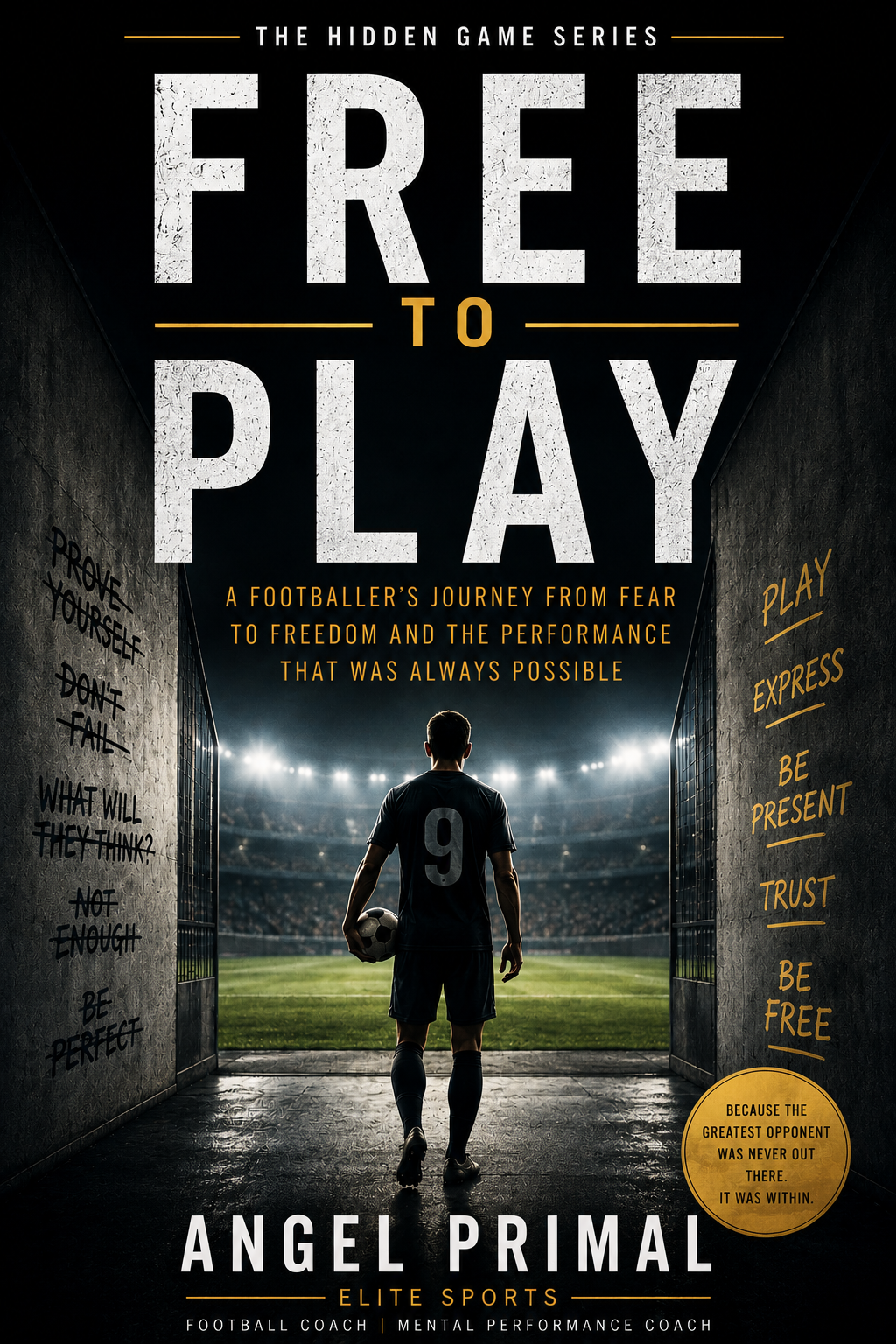
Author’s Note
For decades, football has been studied through technique, tactics, physical preparation, and strategy.
All of them are important.
All of them contribute to performance.
But there is one dimension of the game that rarely receives the same attention.
The psychological dimension.
Over the years, I have observed something that repeats itself again and again.
Extraordinarily talented players who are unable to express everything they carry within them.
Footballers who shine in training and disappear in matches.
Players who seem free when nobody is watching and tense when they feel that something important is at stake.
When I was young, I believed the explanation was related to confidence, experience, or preparation.
As the years passed, I began to suspect the problem was deeper.
I discovered that many footballers were not fighting a lack of ability.
They were fighting themselves.
Against fear.
Against pressure.
Against the need to prove.
Against invisible stories that shaped every decision they made on the pitch.
This book was born from a question:
Why do some players express their talent freely while others spend years trapped by something they cannot even identify?
The answer may lead you to a conclusion that will transform the way you understand performance.
The greatest obstacle in elite football is rarely the opponent.
Far too often, it is the unconscious story the player believes about himself.
This guide is an introduction to a new way of seeing.
An invitation to explore the match that nobody sees.
Because elite football is not primarily a technical game.
It is a psychological game.
PART I
THE MATCH NOBODY SEES
Chapter 1
The Invisible Match
Every footballer plays two matches at the same time.
The first is visible.
It is played on the pitch.
It includes opponents, teammates, coaches, tactical systems, refereeing decisions, and results.
It is the match everyone watches.
It is the match that appears in the statistics.
It is the match that is analyzed on television.
But there is another match.
A silent match.
An invisible match.
A match that takes place in the player’s mind.
That match is made up of thoughts.
Emotions.
Expectations.
Memories.
Fears.
Interpretations.
And although nobody can see it, it often determines the outcome of the first one.
Two players can face exactly the same situation.
One plays freely.
The other plays constrained.
One expresses his ability.
The other tries to protect himself.
From the outside, they appear to be doing the same thing.
Internally, they are living completely different experiences.
Most sports development programs focus on improving the visible match.
Very few explore the invisible match.
Yet when we examine the careers of many footballers, we discover that the greatest differences are rarely technical.
They are psychological.
The question is not only what a player knows how to do.
The question is whether he can access it when he needs it most.
Because talent does not disappear.
What disappears is access to talent.
And when that happens, the problem is rarely technical.
It is psychological.
Chapter 2
The Invisible Opponent
When we think about opponents, we think about strikers, defenders, coaches, or teams.
We think about external obstacles.
But there is another opponent.
An opponent that follows the player into every training session.
Every match.
Every decision.
It is a silent opponent.
And precisely because of that, it is so difficult to detect.
This opponent takes many forms.
Fear of failure.
Fear of rejection.
Fear of judgment.
Fear of disappointing others.
Fear of not being enough.
Most footballers would never say:
«I am afraid.»
Instead, they would say:
«I don’t feel comfortable.»
«I don’t feel confident.»
«I’m not being myself.»
«Things just aren’t working for me.»
Yet beneath all of these experiences lies the same mechanism.
Fear.
Fear does not always appear as obvious anxiety.
More often, it appears in disguise.
As perfectionism.
As overanalysis.
As the need for control.
As conservative play.
As indecision.
As the loss of spontaneity.
The player still appears technically capable.
But something has changed.
He is no longer expressing himself.
He is protecting himself.
And there is a huge difference between the two.
Expression creates creativity.
Protection creates limitation.
Expression expands.
Protection contracts.
One of the fundamental discoveries of Free to Play is that many players believe they are playing football.
Psychologically, they are actually playing to protect an image of themselves.
And while that is happening, an important part of their ability remains inaccessible.
Because the most difficult opponent in football is often the one nobody can see.
Chapter 3
Why Talent Is Not Enough
We have all known extraordinarily talented players.
Players capable of doing things that others simply cannot do.
Players who stand out from an early age.
Players who seem destined for success.
Yet football is full of stories that challenge a very popular belief:
The idea that talent is enough.
If talent were enough, every great prospect would reach the elite level.
If talent were enough, every technically brilliant player would thrive under pressure.
If talent were enough, football would be far more predictable than it actually is.
But it is not.
Reality shows us something different.
Talent matters.
Of course it matters.
But talent alone guarantees nothing.
Because there is a fundamental difference between possessing an ability and being able to express it.
Many footballers live with a feeling that is difficult to describe.
They know there is more inside them.
They have felt it.
They have experienced it during certain training sessions.
In particular matches.
In isolated moments when everything seemed to flow naturally.
During those moments, there was no fear.
No doubt. No overthinking.
They simply played.
And this leads to an important question:
If that ability already exists, what prevents access to it consistently?
The answer brings us to the central concept of this guide.
Not all performance problems are ability problems.
Many are access problems.
The player possesses more than he expresses.
The challenge is accessing it when he needs it most.
And the greater the pressure, the more obvious this difference becomes.
This is why some footballers seem like different players depending on the context.
Not because their talent changes.
But because their access to that talent changes.
This distinction completely transforms the way we understand performance.
The real challenge is not always developing new abilities.
Sometimes it is removing whatever prevents the expression of the abilities that already exist.
Chapter 4
The Freedom Gap
One of the most important concepts in Free to Play is what we call The Freedom Gap.
Most players believe that the distance between their current level and their best version is a matter of development.
More training.
More experience.
More confidence.
More preparation.
Sometimes that is true.
But often another type of distance exists.
A psychological distance.
The distance between potential ability and expressed ability.
We can imagine it like this:
Potential Ability
minus
Psychological Interference
equals
Expressed Ability
This is not a mathematical formula.
It is a different way of looking at performance.
Many players already possess more resources than they currently display.
More creativity.
More courage.
More vision.
More spontaneity.
More leadership.
More decision-making ability.
But all of these resources become partially hidden when certain forms of psychological interference appear.
Fear.
Pressure.
The need for approval.
Perfectionism.
Constant concern about results.
The obsession with avoiding mistakes.
All of these act as an invisible barrier.
The player still has talent.
But he can no longer access it with the same freedom.
This is why two footballers with similar abilities can produce radically different performances.
The difference is not always in what they possess.
The difference is usually in what prevents them from expressing it.
The real question stops being:
How can I become a better player?
And becomes:
What is interfering with the player I already am?
PART II
HOW PRESSURE IS CREATED
Chapter 5
The Prison of Identity
Every footballer develops an identity.
It is natural.
We need to build an image of who we are.
We need to feel that we belong somewhere.
We need to define ourselves.
That is why thoughts such as these appear:
I am a starter.
I am the goalscorer.
I am the captain.
I am the team’s future star.
I am mentally strong.
At first, these identities seem positive.
And many times they are.
The problem begins when we stop using identity and start depending on it.
When an identity stops being a description and becomes a necessity.
From that moment, something very subtle begins.
The player is no longer playing solely to compete.
He begins playing to protect an image.
And every image needs to be defended.
If I am the star, I must prove it.
If I am the leader, I cannot show weakness.
If I am the future prospect, I cannot disappoint.
Identity creates invisible obligations.
And those obligations create pressure.
Little by little, football stops being an experience of expression.
It becomes an experience of protection.
The player is no longer simply playing a match.
He is trying to preserve who he believes he must be.
And that burden has a price.
A psychological price.
Chapter 6
Identity Debt
Every identity creates a debt.
An invisible debt.
A psychological debt.
If I believe I must be the best player on the team, I have to prove it constantly.
If I believe I must justify other people’s expectations, I have to satisfy them constantly.
If I believe my worth depends on my results, I need to produce results constantly.
The stronger the identity, the greater the debt.
And the greater the debt, the greater the pressure.
Many players live trapped in this dynamic without realizing it.
Their energy is no longer directed solely toward the game.
A significant part of it is consumed by trying to maintain a particular image.
Trying to protect a particular narrative.
Trying to sustain a particular version of themselves.
The consequence is that every mistake feels heavier.
Every criticism hurts more.
Every time they are left out of the lineup becomes more difficult.
Every poor performance becomes more personal.
The problem is not the event.
The problem is the meaning the player gives to the event.
Because when identity is at stake, every result feels like a threat.
And when football becomes a threat, freedom begins to disappear.
This is where the cycle that affects so many footballers begins:
Identity.
Fear.
Pressure.
Limitation.
The rest of this journey is about discovering how to step out of it.
Chapter 7
The Protection Game
Most footballers believe they are playing football.
Psychologically, however, many are playing something else.
They are playing to protect themselves.
Protect their reputation.
Protect their status.
Protect other people’s expectations.
Protect their place on the team.
Protect the image they have of themselves.
This process is usually completely unconscious.
The player does not walk onto the pitch thinking:
«Today I am going to protect my identity.»
What happens is far more subtle.
He begins avoiding risks.
He begins playing safe.
He begins making decisions that reduce the possibility of making mistakes.
Little by little, he stops expressing himself.
And begins defending himself.
The problem is that protection consumes energy.
Every thought devoted to avoiding a mistake is energy no longer available for creating.
Every concern about other people’s opinions is attention no longer available for the game.
Every attempt to protect an image reduces freedom of expression.
This is where one of the great paradoxes of performance appears.
The more a player tries to protect himself, the less free he becomes.
And the less free he becomes, the worse he usually performs.
What began as an attempt to avoid failure eventually becomes one of the causes of failure.
Protection creates rigidity.
Expression creates freedom.
And elite football demands freedom.
Because nobody can play their best football while trying to protect themselves at the same time.
Chapter 8
Perfectionism: Fear in Disguise
Many players consider perfectionism a virtue.
They associate it with discipline.
With professionalism.
With high standards.
With ambition.
But there is an important difference between excellence and perfectionism.
Excellence seeks growth.
Perfectionism seeks to avoid mistakes.
Excellence embraces learning.
Perfectionism fears judgment.
Excellence supports development.
Perfectionism supports protection.
Very often, perfectionism is not born from ambition.
It is born from fear.
Fear of making mistakes.
Fear of disappointing others.
Fear of appearing inadequate.
Fear of not measuring up.
That is why many perfectionist players live trapped in a contradiction.
They work harder than anyone else.
They demand more from themselves than anyone else.
They analyze every detail.
And yet they rarely feel at peace.
Because perfectionism is never satisfied.
It always finds something to correct, improve, or criticize.
Excellence allows a player to enjoy the process.
Perfectionism turns the process into a permanent examination.
And when every training session and every match feels like a test, football stops being a game.
It becomes a threat.
PART III
FROM FEAR TO FREEDOM
Chapter 9
The Psychological Handbrake
Imagine a high-performance car.
A powerful engine.
Great acceleration.
Everything is working properly.
Yet the handbrake remains partially engaged.
The car still moves forward.
But it does not move freely.
Movement becomes heavier.
Acceleration becomes inconsistent.
Driving requires more effort.
Most people would assume the problem lies in the engine.
They would look for more power.
More fuel.
More technology.
But the problem is not in the engine.
The problem is in the brake.
This metaphor summarizes the experience of many footballers.
They possess ability.
They possess preparation.
They possess experience.
Yet something interferes.
Fear.
Pressure.
The need to prove.
Attachment to outcomes.
Self-judgment.
All of these function as a psychological handbrake.
The usual response is to add something more.
More training.
More mental preparation.
More confidence.
But sometimes the real solution is not to add.
It is to let go.
Because the goal is not to build a new engine.
The goal is to free the one that already exists.
Chapter 10
The Confidence Paradox
Few words appear as frequently in sport as confidence.
Players.
Coaches.
Journalists.
Everyone talks about it.
When performance improves, people say there is confidence.
When performance declines, people say confidence is lacking.
But there is an important question:
What is confidence, really?
Most footballers believe the relationship works like this:
Confidence
↓
Performance
In other words, confidence comes first and performance follows.
However, experience suggests something different.
Many times, confidence disappears after a few poor results.
If it were a solid quality, why would it change so quickly?
Because what we often call confidence is simply validation.
We feel secure when things go well.
We feel insecure when things go badly.
Free to Play proposes a different perspective.
Freedom
↓
Expression
↓
Performance
↓
Confidence
Confidence is not always the starting point.
Many times, it is the consequence.
When the player stops protecting himself, he expresses himself.
When he expresses himself, he gains access to more of his ability.
When he gains access to more of his ability, performance improves.
And when performance improves, confidence appears naturally.
Perhaps the real question is not:
How do I get more confidence?
But rather:
What is preventing me from playing freely?
Chapter 11
The Free Player
The free player still wants to win.
He is still competitive.
He still works hard.
He still has goals.
The difference is that he is no longer playing to prove who he is.
He no longer needs football to confirm his worth.
He no longer depends on every result in order to feel enough.
That is why he can take risks.
That is why he can make mistakes.
That is why he can recover more quickly.
Because mistakes no longer threaten his identity.
The free player is not free from fear.
He is free from the need to obey fear.
That completely changes the experience of the game.
His attention is directed toward expression.
Not protection.
Toward possibility.
Not threat.
Toward the present.
Not imagined consequences.
And that is precisely why he often appears more creative.
More courageous.
More spontaneous.
More authentic.
Freedom does not eliminate competition.
It transforms it.
Chapter 12
Freedom as a Competitive Advantage
Most players search for visible advantages.
Better preparation.
Better nutrition.
Better tactics.
Better physical conditioning.
All of these are important.
But there is another advantage.
An invisible advantage.
Psychological freedom.
When a player stops spending energy protecting himself, that energy becomes available for competition.
Available for creating, adapting, expressing, and leading.
The free player thinks more clearly.
Recovers more quickly from mistakes.
Tolerates uncertainty more effectively.
Handles pressure more effectively.
Not because he is perfect.
But because he is no longer fighting himself.
And when a person stops fighting himself, something extraordinary becomes possible.
He gains access to a part of his potential that was always there.
That is why freedom is not the reward for performance.
It is often the condition that makes performance possible.
Chapter 13
The Free to Play Path
Throughout this guide, we have explored different aspects of the footballer’s psychological experience.
Fear.
Pressure.
Identity.
The need to prove.
The search for confidence.
Although they may appear to be separate topics, they are all part of the same process.
A process that can be represented by a simple sequence.
IDENTITY
↓
FEAR
↓
PRESSURE
↓
LIMITATION
↓
AWARENESS
↓
FREEDOM
↓
EXPRESSION
↓
PERFORMANCE
This sequence summarizes the central philosophy of Free to Play.
Everything begins with an identity.
An idea about who we believe we must be.
That identity generates fear.
Fear of losing it.
Fear of not measuring up.
Fear that others will discover something we do not want to see.
Fear creates pressure.
Pressure alters attention.
Altered attention limits expression.
The ability still exists.
But access to it diminishes.
However, the process does not end there.
There is a turning point.
Awareness.
The moment when the player begins to observe what he previously took for granted.
The moment when he discovers that perhaps he is not his thoughts.
That perhaps he is not his results.
That perhaps he is not the story he has been protecting.
From that understanding, something new emerges.
Freedom.
And when freedom appears, expression emerges.
And when expression emerges, performance begins to transform.
Most performance systems start with performance.
Free to Play starts with freedom.
Because freedom is the ground where performance can flourish.
PART IV
BEYOND FOOTBALL
Chapter 14
This Was Never Just About Football
As we go deeper into these ideas, an unexpected realization begins to emerge.
This book appears to be about football.
But in reality, it is about something much broader.
The same psychological forces that affect a player affect every human being.
The need for approval.
The fear of rejection.
Constant comparison.
The search for validation.
The pressure to prove oneself.
All of these exist both inside and outside sport.
This is why many readers will discover something curious.
They will begin reading about football.
And end up reflecting on their own lives.
Because the problem was never simply a bad match.
Or a bad season.
Or a poor run of form.
The problem was always the relationship we had with ourselves.
Football merely made visible something that was already there.
The lessons of this book do not end when the match ends.
They continue at work.
In relationships.
In leadership.
In family life.
In any situation where we feel our worth depends on proving something.
The freedom that improves performance is the same freedom that improves life.
Chapter 15
The Central Question
This book revolves around a question.
The central question of Free to Play is simple.
But it is also profoundly challenging.
What invisible belief is preventing you from expressing your natural ability?
This is not a technical question.
It is not a tactical question.
It is not a physical question.
It is a psychological question.
Because in many situations, what limits the player is not what is happening outside.
It is what is happening inside.
A story.
An interpretation.
An unconscious conclusion.
Perhaps it is:
«I am not enough.»
«I have to prove my worth.»
«I cannot make mistakes.»
«I cannot disappoint anyone.»
«My performance determines who I am.»
Each person has his own version.
But they all create the same effect.
They separate the individual from his natural expression.
This is why the real work is not simply about improvement.
It is about discovery.
Discovering which story is silently governing our experience.
And asking whether it is actually true.
Awareness begins with a question.
Freedom does too.
Chapter 16
Free to Play
Imagine for a moment a child playing football with friends.
There are no contracts.
No statistics.
No social media.
No pressure.
No expectations.
No need to prove anything.
There is only the game.
There is only curiosity.
There is only movement.
There is only the joy of playing.
Most great footballers started this way.
Playing.
Exploring.
Creating.
Expressing themselves.
Over time, demands appeared.
Evaluations.
Comparisons.
Expectations.
And little by little, that freedom began to disappear.
The paradox is that many players spend years trying to recover something they once knew.
They are not only searching for success.
They are searching to feel free again.
The purpose of this book is not to turn you into someone else.
It is not to build a new identity.
It is not to teach you how to fake confidence.
The goal is much simpler.
To help you recognize what interferes with your natural expression.
Because when the interference disappears, what was always there begins to emerge.
Your ability.
Your creativity.
Your presence.
Your authenticity.
Your game.
The essence of Free to Play can be summarized in a single sentence:
The player who becomes free from fear gains access to abilities that were always within him.
EPILOGUE
The Invitation
For years, you may have believed that your greatest challenge was becoming more.
Stronger.
More confident.
More disciplined.
More resilient.
Better prepared.
And surely part of that effort has been necessary.
But there is another possibility.
The possibility that the real challenge was never about adding.
The possibility that the real challenge has always been about letting go.
Letting go of fear.
Letting go of pressure.
Letting go of the need to prove.
Letting go of the stories that force you to protect an image.
Because what we call growth is not always about accumulating.
Sometimes it is about releasing.
Freedom does not guarantee success.
Freedom does not guarantee trophies.
Freedom does not guarantee recognition.
But it does create access.
Access to a more authentic version of yourself.
Access to a fuller expression of your ability.
Access to a different way of competing.
And perhaps a different way of living.
Elite football will continue to be demanding.
There will still be pressure, mistakes, and challenges.
But when your identity no longer depends on them, something changes.
You compete with greater clarity.
You play with greater courage.
You recover more quickly.
You express yourself with greater freedom.
And you discover that much of what you were searching for was already within you.
Because elite football is not primarily a technical game.
It is a psychological game.
And the player who becomes free from fear gains access to abilities that were always there.
REAL GAME SITUATIONS
When Training and Match Day Feel Like Different Sports
Many footballers have experienced this.
During the week, they train freely.
Decisions flow.
Actions emerge naturally.
Everything feels simple.
Yet match day arrives and something changes.
The mind becomes noisier.
Decisions take longer.
Confidence decreases.
The game feels heavier.
Traditionally, this difference is attributed to pressure.
But what exactly changes?
The technique is the same.
The physical ability is the same.
The tactical understanding is the same.
What changes is the meaning.
In training, we rarely feel that our worth is on the line.
In a match, we often do.
And when something important appears to be at risk, protection emerges.
Protection creates tension.
Tension limits expression.
And limited expression looks like a lack of ability.
When in reality, it is a lack of freedom.
The Fear of Making Mistakes
Imagine a midfielder.
He receives the ball between the lines.
He has a vertical option.
A creative option.
A risky option.
He also has a safe option.
A sideways pass.
A risk-free pass.
Many times, he will choose the safe pass.
Not because it is the best decision.
But because it is the safest psychologically.
Fear rarely appears saying:
«I am afraid.»
It appears disguised as caution.
As analysis.
As responsibility.
As tactical intelligence.
And that is precisely why it is so difficult to detect.
When Results Become Personal
Two players miss a penalty.
The first thinks:
«I missed a penalty.»
The second thinks:
«I have proven that I am not ready.»
The action is the same.
The experience is completely different.
The first experiences an event.
The second experiences a threat to his identity.
And when identity enters the equation, suffering increases.
The difference is not in the mistake.
It is in the meaning assigned to the mistake.
The Player Who Needs to Prove
Many footballers live trapped in a silent mission.
To prove that they are good enough.
That they have talent.
That they belong at that level.
That they deserve to play.
The problem is that the mission never ends.
Because every proof requires a new proof.
And every validation requires a new validation.
The player eventually turns every training session into an examination.
Every match into an evaluation.
Every mistake into a threat.
And football stops being a space for expression.
It becomes a space for survival.
REFLECTION EXERCISES
Exercise 1
The Fear Beneath the Fear
Complete the following sentences:
I am afraid of…
If that happened, it would mean that…
And that would say about me that…
Do not look for correct answers.
Look for honest answers.
Exercise 2
The Story I Am Protecting
Complete:
I need other people to see me as…
I am afraid they will see me as…
If that image disappeared, I would feel…
Exercise 3
My Football Without Fear
Imagine that during a match the following disappear:
• Fear of making mistakes
• Fear of judgment
• Fear of failure
• The need to prove yourself
How would you play?
What decisions would you make?
What actions would you attempt?
What version of yourself would emerge?
Write it down.
THE FREE TO PLAY™ MODEL
The Path from Limitation to Expression
IDENTITY
↓
FEAR
↓
PRESSURE
↓
LIMITATION
↓
AWARENESS
↓
FREEDOM
↓
EXPRESSION
↓
PERFORMANCE
An Important Observation
Most performance programs begin with the final word:
Performance.
Free to Play begins with a different word:
Freedom.
Because performance is visible.
Freedom is causal. Freedom is the source.
Performance is the result.
FINAL REFLECTION
Perhaps you never lacked talent.
Perhaps you never lacked ability.
Perhaps you never lacked potential.
Perhaps what you lacked was access.
Access to a version of yourself that was always there.
A version less concerned with proving.
Less occupied with protecting itself.
Less conditioned by fear.
More present.
More free.
More authentic.
Because the player who becomes free does not become someone else.
He simply stops interfering with who he already is.
And in that moment, something extraordinary happens.
Football begins to feel like a game again.
And the player begins to play again.
Free to Play.
THE PARADOXES OF PERFORMANCE
Ideas That Seem Contradictory but Can Change the Way You Play
Paradox 1
The More You Try to Prove Yourself, the Less You Express Yourself
Many players believe they must first prove their worth.
Then freedom will come.
Then confidence will come.
Then expression will come.
But experience shows something different.
When a player steps onto the pitch trying to prove something, tension appears.
And when tension appears, expression decreases.
Creativity decreases.
Spontaneity decreases.
Freedom decreases.
Paradoxically, the need to prove is often precisely what prevents a player from proving anything.
Paradox 2
The More You Protect Yourself, the More Vulnerable You Become
Protecting yourself seems logical.
Avoid mistakes.
Avoid risks.
Avoid responsibility.
Yet many times the opposite happens.
The player begins to play safe.
He loses aggressiveness.
He loses initiative.
He loses presence.
And his performance declines.
Protection ends up creating exactly what it was trying to avoid.
Paradox 3
Confidence Is Not the Starting Point
Most people believe:
Confidence
↓
Performance
But many times the real process is:
Freedom
↓
Expression
↓
Performance
↓
Confidence
Confidence is often the result of an experience of freedom.
Not its cause.
Paradox 4
Fear of Failure Can Be More Harmful Than Failure Itself
Failure is part of sport.
Every player fails.
Every player makes mistakes.
Every player goes through difficult periods.
The real problem is rarely failure itself.
It is the interpretation of failure.
When a mistake becomes a threat to identity, suffering appears.
And when suffering appears, fear begins to control behavior.
Paradox 5
Freedom Creates Discipline
We normally think of freedom and discipline as opposites.
Yet the freest players are often the most committed.
Why?
Because they no longer need to fight themselves.
Discipline stops being an obligation.
It becomes a choice.
THE TRUE MEANING OF FREE TO PLAY
A common misunderstanding often arises.
Some people believe freedom means the absence of ambition.
The absence of standards.
The absence of responsibility.
That is not what this book means.
The freedom discussed here is not freedom from competition.
It is freedom from the psychological burden that limits competition.
The free player still wants to win.
He still trains hard.
He still demands a lot from himself.
He still pursues goals.
But he no longer needs to use football to prove his personal worth.
And precisely because of that, he can compete with greater intensity.
Not less.
THE DIFFERENCE BETWEEN SUCCESS AND FREEDOM
Many sporting careers are built around a single idea:
«When I achieve this, I will finally feel enough.»
When I sign that contract.
When I play at that level.
When I become a starter.
When I win that championship.
When I score those goals.
The problem is that the feeling rarely lasts.
A new goal appears.
A new comparison.
A new demand.
And the search continues.
Free to Play proposes a different question.
What happens when we stop looking for our worth in results?
What happens when we stop turning performance into proof of who we are?
Perhaps then we discover something important.
Performance may improve.
But our worth never depended on it.
THE MOST IMPORTANT MESSAGE IN THE BOOK
If there were only one idea to remember after reading these pages, it would be this:
Most footballers are not limited by a lack of ability.
They are limited by invisible stories that interfere with their ability.
Stories about failure.
Stories about success.
Stories about approval.
Stories about personal worth.
Stories about who they believe they must be.
Freedom begins when those stories stop being unquestioned truths.
A QUESTION FOR THE REST OF YOUR CAREER
Before finishing this guide, take a few minutes.
Breathe.
Reflect.
And answer honestly:
What story am I protecting?
Not the story other people tell.
Not the story other people expect.
Yours.
The one that appears before matches.
The one that appears after mistakes.
The one that appears when you doubt.
The one that appears when you are afraid.
Because perhaps that is where the origin of much of your experience as a footballer can be found.
And perhaps it is also where your freedom begins.
WHEN THEORY BECOMES EXPERIENCE
The ideas in this book may seem abstract.
Identity.
Fear.
Pressure.
Freedom.
Yet for most footballers, these forces are not concepts.
They are daily experiences.
They appear in training.
They appear in matches.
They appear in the decisive moments of a career.
What is interesting is that they rarely present themselves openly.
Fear rarely announces itself as fear.
Pressure rarely reveals its true source.
The need to prove rarely recognizes its own presence.
This is why many players spend years experiencing the effects without fully understanding what is producing them.
The following stories represent situations that thousands of footballers have experienced in one way or another.
They do not belong to specific players.
They belong to football itself.
Perhaps you will recognize yourself in some of them.
Perhaps you will discover aspects of your own experience that have remained hidden until now.
Because an idea can be understood intellectually.
But when a story reflects us, understanding becomes personal.
And that is where real transformation begins.
STORY 1
The Academy Player Who Played With Fear
When he was twelve years old, football was simple.
He received the ball and played.
He attempted impossible dribbles.
He tried difficult passes.
He took risks.
Sometimes it worked.
Sometimes it didn’t.
It did not matter much.
He played because he loved the game.
As the years passed, he began to stand out.
The praise arrived.
The expectations.
Comments from coaches.
Comments from his parents.
Comments from other players.
Little by little, he began to hear a new story.
«You are one of the best.»
At first, he liked it.
Then he started protecting it.
He no longer wanted to be one of the best.
He needed to remain one of the best.
Every training session began to feel different.
Every mistake seemed more important.
Every poor performance felt like a threat.
Without realizing it, he stopped playing to express himself.
He began playing to protect an image.
From the outside, he remained talented.
On the inside, he was no longer free.
The irony was obvious.
The more he tried to protect his talent, the less capable he became of expressing it.
His problem was never technical.
His problem was psychological.
He did not need more ability.
He needed less fear.
Reflection
How many times have you stopped attempting something you were perfectly capable of doing because a part of you was afraid of making a mistake?
STORY 2
The Professional Who Never Felt Good Enough
He had achieved what millions of people dream of.
He was a professional footballer.
He made a living from the sport he loved.
He played in front of thousands of supporters.
He had contracts.
Recognition.
Financial stability.
From the outside, he appeared successful.
Inside, he was living a very different experience.
Every season began the same way.
He needed to prove that he deserved to be there.
Every match felt like an examination.
Every time he was left out felt like rejection.
Every mistake felt like a threat.
He lived in a constant state of tension.
When he played well, he felt relief.
When he played badly, he felt anxiety.
His emotional state depended entirely on his results.
For years he believed his problem was confidence.
He tried to improve it.
He read books.
He worked with coaches.
He listened to motivational talks.
Nothing changed very much.
Until he discovered something.
His problem was not confidence.
His problem was that he had turned football into a test of his personal worth.
He was not playing to compete.
He was playing to feel good enough.
And no result could ever permanently solve that problem.
Because the problem had never been football.
It was a question of identity.
The day he began separating his personal worth from his results, something unexpected happened.
Winning still mattered.
Performing still mattered.
He simply stopped depending on it in order to feel valuable.
And for the first time in many years, he felt free again.
Reflection
What results are you currently using to measure your value as a person?
STORY 3
The Young Prospect
Everyone knew he had talent.
The coaches could see it.
His teammates could see it.
His family could see it.
Even he knew it himself.
During training sessions, he stood out naturally.
In normal matches, he played well.
He seemed destined to go far.
Yet there was a problem.
Every time an important match arrived, something changed.
A final.
A decisive tournament.
A match against a major opponent.
A game with scouts in the stands.
Suddenly, he no longer looked like the same player.
He thought too much.
He doubted himself more than usual.
He made conservative decisions.
He avoided risks.
And he played far below his true level.
After every important match, he asked himself the same question.
Why can’t I show what I am truly capable of?
For years he believed the problem was pressure.
But little by little, he began to understand something deeper.
The pressure did not come only from the match.
It came from what the match meant.
In those moments, he was not only playing football.
He was trying to prove that he deserved all the expectations others had placed upon him.
He was trying to prove that he was as good as people said.
He was trying to prove that he was destined to go far.
And the more he tried to prove it, the harder it became to play.
Because fear had replaced freedom.
One day he understood something that would change the way he competed.
Important matches were not an examination of his personal worth.
They were simply matches. They were still important.
They were still demanding.
But they no longer defined who he was.
And when he stopped turning every big occasion into a test of himself, he began to play with a freedom he had been searching for for years.
The talent had always been there.
The only thing missing was access to it when he needed it most.
Reflection
Are there moments when you stop playing to express yourself and start playing to prove something?
And what would happen if those moments stopped defining who you are?
About the Author of Free to Play
Ángel Álvarez, known online as Angel Primal, is a Primal Therapist and Family Constellations Coach.
Before dedicating himself fully to transformational work, he played football in Spain and later in California during the 1980s. He also worked alongside football coaches, experiences that sparked his interest in the psychological factors that influence athletic performance.
For more than three decades, he has explored transformational therapies related to personal growth and human potential.
Since 2003, he has facilitated nearly 4,000 Family Constellations and led hundreds of workshops.
In recent years, he has integrated insights from Peter Crone, George Mumford, Michael Gervais, and Tim Grover into his coaching methodology, developing an approach centered on psychological freedom as the foundation of performance and the expression of human potential.
He is also the creator of Emotional Architect and other websites:
AngelPrimalcom – ArquitectoEmocional.com – ConstelacionesFamiliares.es