
CONTENTS
ALL CHAPTERS IN IMAGES
In Spanish:
AngelPrimal.com/la-mirada
Free eBooks Online:
AngelPrimal.com/books-free
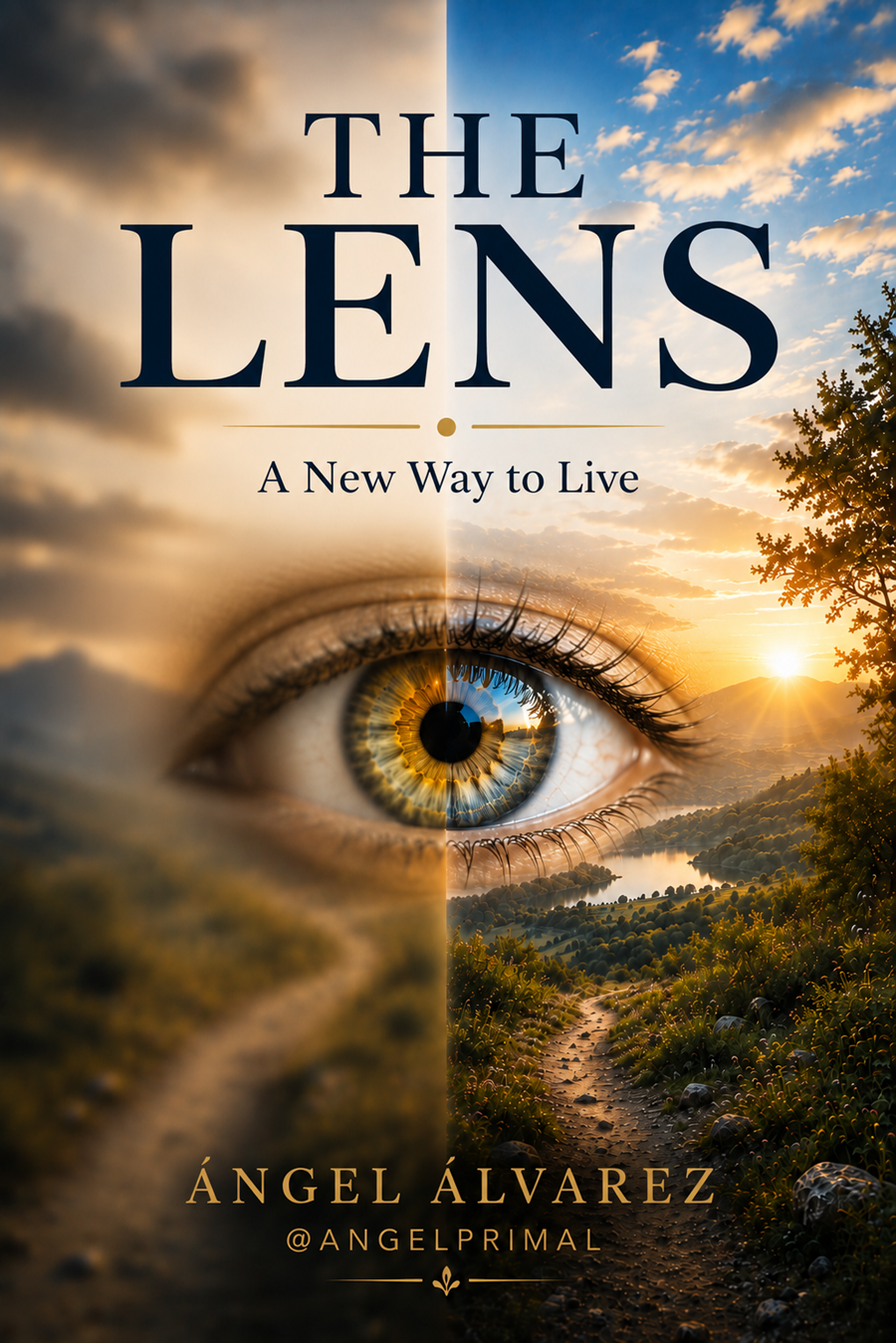
📕 PRINTED BOOK — AVAILABLE ON AMAZON
More Amazon books: AngelPrimal.com/books
SUMMARY, TABLE OF CONTENTS, AND 3 CHAPTERS FROM THE LENS
(Text and Audio)
My gratitude to artificial intelligence, whose help in structuring and shaping these pages made it possible
to complete this book in far less time than it would otherwise have required.
Like any tool, its value depends on how we use it.
Human experience remains the source and the heart of these pages.
Book Summary
The Lens: A New Way To Live
There are moments when nothing changes.
And yet, everything begins to feel different.
Not because the world has changed.
But because the way we see it has.
We all learned a particular way of looking at life.
We learned what love was supposed to mean.
What it meant to belong.
What it meant to suffer.
And over time, we came to believe that this way of seeing was reality itself.
Perhaps personal growth is not about becoming someone else.
Perhaps it is about discovering who we are when we stop seeing through fear, expectation, or the need to control.
We cannot change what has already happened.
But we can transform the relationship we have with our past.
Peace does not arise when every problem disappears.
It begins when we stop fighting against what is already part of our story.
Every person carries a story that cannot always be seen.
That is why understanding is often more transformative than judging.
And listening can change more lives than trying to convince.
There is a way of seeing that does not diminish.
That does not label.
That leaves room for life to continue revealing itself.
Perhaps freedom is not about having all the answers.
Perhaps it is about learning to see with greater presence, greater truth, and greater love.
The Lens is not a book of formulas.
It is an invitation to pause.
To observe.
And to discover that when the way we look changes, the way we live changes as well.
HERE YOU CAN LISTEN TO AND READ THREE CHAPTERS (2, 8, AND 25)
Chapter 2 – Audio
Chapter 2
The Story That Lives Within Us
There are memories that stay with us for a lifetime.
Not because they were the most important.
But because, without realizing it, they began to shape the way we learned to be in the world.
I remember a Sunday morning.
I must have been six or seven years old.
My sister was a year younger, and my little brother was only three.
We were living in our home in Oviedo (Asturias), in northern Spain.
My father became angry with my mother because she couldn’t get the coal stove to light.
She left the house, while he went back to bed, still upset.
My siblings and I were in our bedroom.
To me, the solution seemed obvious.
If I could light the stove, the problem would disappear, and everything would be alright again.
I convinced my brother and sister to help me.
I knew it took a match and a little oil.
But I poured in far too much.
The stove wouldn’t catch, and the noise woke my father.
«What are you doing?» he shouted from his bedroom.
«Nothing,» I answered.
A moment later, we heard him getting up.
We ran back toward our room.
I was the last one to get there.
Just as I was about to reach my bed, he kicked me.
It wasn’t a hard kick.
But I burst into tears.
I wasn’t crying because of the pain.
I was crying because it felt unfair.
All I had wanted was for everything to be alright again.
My father walked into the kitchen, realized what had happened, and only a few seconds later came back to comfort me.
He couldn’t bear to see a child cry.
I still remember thinking, as he tried to calm me down:
«At least let me cry.»
Years later, I realized that something else had happened that morning.
Without noticing it, I had begun to learn that expressing my feelings also caused suffering.
Little by little, I stopped crying.
I believed that if I stopped crying, I would stop being another problem.
That morning I didn’t just try to light a stove.
I also began to build a way of being in the world.
For many years, I believed that if I could ease the suffering of the people I loved, everything would be alright again.
With time, I came to understand that each person has their own path to walk.
That there are lessons no one can live for us.
And that no child should ever feel responsible for their family’s well-being.
We all have a story.
Not only the one we remember.
But also the one we’ve forgotten.
The one we never fully understood.
The one someone chose not to tell.
The one left suspended between silences, glances, and gestures that, as children, we didn’t yet know how to interpret.
When we think about our story, we often imagine a sequence of events.
Where we were born.
The family we grew up in.
School.
Friends.
Losses.
Love.
Successes.
Mistakes.
But a story is far more than a collection of memories.
It is the way those experiences left their mark on us.
Two siblings can grow up under the same roof and carry completely different stories.
Not because the events were different.
But because each one lived a unique experience.
Our story is not only what happened.
It is also the meaning we gave to what happened.
We often believe the past is behind us.
We say,
«That’s over.»
And yet, the past has a remarkable way of remaining present.
Not always through memories.
Sometimes it appears in our decisions.
In what we avoid.
In what we seek.
In the people we choose.
In the conflicts that keep repeating themselves.
In fears we cannot explain.
We believe we are responding to the present.
But many times, we are responding to a story that is still speaking within us.
Not to punish us.
Not to keep us from living.
But because it is still waiting to be heard.
Life has a quiet wisdom.
What cannot be expressed in one way will often find another.
A silenced emotion can become distance.
An unacknowledged loss can become a sadness without a name.
A deep need to belong can lead us to accept places where we stop being ourselves.
None of this happens because there is something wrong with us.
It happens because every experience needs to find its rightful place.
And when it doesn’t, it keeps searching.
Understanding our story is not about remembering more.
Nor does it depend only on memory.
Above all, it depends on the way we see.
The same childhood can be viewed through guilt…
or through understanding.
The same loss can be lived through anger…
or through acceptance.
The same parents can remain an open wound…
or, over time, become part of a larger story.
The facts do not change.
Our perspective does.
And when our perspective changes, our story begins to occupy a different place within us.
It does not disappear.
It may never stop hurting completely.
But it no longer silently governs every step we take.
Personal growth is not about forgetting what we have lived.
It is about being able to hold our story without allowing it to continue directing our lives.
Pause for a moment.
Don’t try to answer yet.
Just observe.
What stories are still living inside you?
Which ones have you told countless times?
Which ones have you never been able to name?
Don’t try to change them.
Simply look at them.
Every transformation begins the moment we are able to look at something without needing to filter it, reject it, or turn away.
Chapter 8 – Audio
Chapter 8
The Power of Acknowledgment
There are words we use so often that we rarely stop to consider what they truly mean.
One of them is acknowledgment.
We say we recognize a place.
A voice.
A face.
An emotion.
But there is another kind of recognition—one that runs much deeper.
It is the kind that transforms our relationship with life.
We are always searching for answers.
We want to understand why we suffer.
Why a relationship ended.
Why certain experiences keep repeating themselves.
We assume that change will come once we find the right explanation.
Over time, we discover something different.
True transformation rarely begins with an explanation.
It begins with acknowledgment.
Acknowledgment does not mean agreement.
It does not mean justification.
Nor does it mean resignation.
To acknowledge is to see reality as it is, even when it bears no resemblance to the reality we wish had existed.
It sounds simple.
Yet few things require more courage.
Because all of us, at some point, have wished life had unfolded differently.
That our parents had acted another way.
That a loss had never happened.
That a relationship had lasted.
That certain words had never been spoken.
There is nothing unusual about this.
It is deeply human.
We have all felt that longing.
But eventually, life asks us a quiet question.
Can you look at what was… without asking it to be different?
This is not a question for the mind.
It is a question for the heart.
As long as part of us continues waiting for a different past, the present struggles to unfold fully.
Acknowledgment does not change the facts.
It changes our relationship with them.
And that difference can transform an entire life.
Acknowledgment Is Not Surrender
Sometimes we mistake acknowledgment for giving up.
We believe that if we accept reality, we stop trying to improve it.
But that isn’t true.
A person can acknowledge an illness while seeking the best possible treatment.
They can acknowledge injustice while continuing to work toward change.
They can acknowledge a loss while still creating a meaningful life.
Acknowledgment never prevents action.
It makes action wiser.
Because we stop fighting what already exists and direct our energy toward what can still be created.
What Needs to Be Seen
In many processes of personal transformation, one lesson appears again and again.
People do not always need immediate solutions.
More often, they simply need something to be seen.
An emotion.
A grief.
A fear.
A story.
A forgotten part of themselves.
Not to dwell in it.
Not to turn it into an identity.
But to give it the place it has been waiting for.
When what has remained hidden is finally allowed to exist, it often loses the need to keep demanding our attention through pain.
Honoring Reality
There is a deeply meaningful expression:
Honor reality.
Not because every reality is easy.
Nor because everything that happened was fair.
We honor reality when we stop denying it.
When we allow it to take its rightful place within our story.
Reality does not need our permission to exist.
But we need to acknowledge it if we want to live fully.
Every time we reject a part of our history, we also reject a part of ourselves.
And living divided requires enormous effort.
Acknowledgment is the beginning of bringing those separated parts back together.
Where Reconciliation Begins
We often believe reconciliation comes at the end of the journey.
In truth, reconciliation begins the very moment we stop denying what was.
That does not mean the pain disappears.
It means we stop turning it into an enemy.
And when we stop fighting against a part of our own story, something within us recovers an energy that has been spent resisting for far too long.
Perhaps that is the first true form of peace.
A Pause
Think of one part of your story that is still difficult to face.
Don’t try to change it.
Don’t try to understand it completely.
Simply ask yourself one question.
What would happen if I stopped wishing it had been different… and simply acknowledged that it is part of my life?
You don’t need to answer right now.
Some questions transform us precisely because they remain open.
Reflection
Long ago, I stopped believing that people change because someone offers them a brilliant interpretation.
I have witnessed far deeper transformations emerge from a much simpler moment.
The moment when someone can quietly say, without resignation and without pride:
«Yes. This, too, is part of my story.»
There is no defeat in those words.
There is truth.
And truth, when it is met with respect, often opens the door to a freedom that no explanation could ever provide.
Chapter 25 – Audio
Chapter 25
Beauty
Perhaps you think beauty belongs to the world of art.
To music.
To painting.
To landscapes.
But above all, beauty belongs to the way we see.
The same sunrise may go unnoticed by one person and become an unforgettable moment for another.
The same forest.
The same rain.
The same silence.
The world has not changed.
Only the way we look at it has.
And when our way of seeing changes, beauty begins to reveal itself where we once saw only familiarity or routine.
Because beauty does not always appear when the world changes.
It appears when we learn to see differently.
Beauty Doesn’t Need to Draw Attention
We live surrounded by endless distractions competing for our attention.
Everything seems determined to be faster.
Brighter.
More intense.
As though only the extraordinary deserved to be noticed.
Beauty works differently.
It is never in a hurry.
And it never raises its voice.
It has no need to impose itself.
It lives in the leaf that falls silently from a tree.
In weathered hands that still know how to caress with tenderness.
In a conversation that ends in a long silence.
In a sleeping child.
In the scent of the earth after the rain.
Beauty rarely asks to be seen.
It simply waits for someone to learn how to notice it.
Learning to Contemplate
There is a difference between seeing something and contemplating it.
Seeing is often quick.
Contemplation requires time.
When we contemplate, we stop using things.
We begin to encounter them.
A tree is no longer just a tree.
It becomes a presence.
A person is no longer merely the role they play.
They begin to reveal themselves as a mystery.
To contemplate is to let go—even if only for a moment—of the need to possess, explain, or classify.
Simply remain.
And allow reality to speak.
Beauty Also Lives Within People
There is something that continues to move me.
People possess a unique beauty when they stop trying to be someone else.
I have seen faces transformed—not because their features changed,
but because the tension of constantly proving who they were simply disappeared.
There is a serenity that makes a person beautiful.
An authenticity that shines.
An inner peace that no youth can replace.
It is the same beauty we see in a small child, before they learned to hide parts of themselves in order to be accepted.
Beauty is not born from perfection.
It is born from truth.
There is a profound beauty in someone who simply shows up as they are.
Without masks.
Without the need to impress.
With the quiet dignity of someone who has made peace with their own life.
Nature Never Pretends
Nature exists in a way that is deeply moving.
The sea never tries to become a mountain.
Winter never apologizes for not being spring.
Trees do not compare their growth.
Each one simply occupies its place.
Each one fully expresses what it is.
Perhaps that is why walking through a forest feels so restorative.
Not only because the air is cleaner.
But because, for a few moments, we reconnect with a way of existing that requires no effort.
Nature does not perform.
It is simply alive.
Perhaps we, too, were created for that same simplicity.
The Beauty of Time
We live in a culture that admires what is new.
What is young.
What is flawless.
And yet, some of the most beautiful things I have ever seen have been shaped by time.
A wooden bench worn smooth by thousands of conversations.
A book filled with handwritten notes.
A face lined with wrinkles that speak of laughter, loss, and hope.
A mother’s hands.
The unhurried pace of an elderly person.
Time does not merely wear things down.
It also reveals them.
Little by little, it strips away what is unnecessary.
And allows what is essential to emerge.
Perhaps that is why some people become more beautiful with age.
Not because time has spared them.
But because it has made them transparent.
Beauty Heals
Perhaps beauty cannot heal us by itself.
Yet I have seen it open a space where life begins to breathe differently.
A piece of music.
A sunset.
The vastness of the sky.
The sound of flowing water.
A work of art.
A poem.
None of these solve our problems.
But they remind us that the world is far greater than our worries.
And that sense of vastness already begins to transform us.
Beauty has an extraordinary gift.
For a few moments, it draws us out of the center of our concerns.
And in doing so, it gives us perspective.
It widens our vision.
The Beauty of Simplicity
As the years pass, we stop chasing extraordinary experiences.
Instead, we begin to discover a quieter kind of beauty.
A meal shared with friends.
Morning coffee.
Reading as evening falls.
The embrace of someone who needs no words.
Spontaneous laughter.
The dog waiting faithfully at the door.
Light streaming through a window.
Perhaps happiness was never hidden in life’s great events.
Perhaps it has always lived in these small moments that our hurried lives prevented us from noticing.
A Pause
Take a slow look at whatever is in front of you.
Don’t search for anything extraordinary.
Notice the light.
The shadows.
The colors.
Breathe.
And ask yourself:
How long has it been since I simply contemplated something without wanting anything from it?
Stay with that question for a while.
You may discover that beauty has been waiting for you all along.
Beauty Is Not a Luxury
With the passing of the years, we begin to understand that beauty is not a luxury.
It is a necessity of the soul.
Not because it takes us away from reality,
but because it brings us back to it.
It reminds us that life is not made only of problems to solve.
It is also made of mysteries to contemplate.
Of encounters to be grateful for.
Of silences to share.
Of sunrises that will never be repeated in exactly the same way.
Perhaps beauty is all of this.
The gentle way in which life invites us, again and again, to return to the present moment.
And perhaps one of the greatest lessons of The Gaze is learning to recognize beauty where we once saw only routine.
Because when beauty returns to our lives, so does wonder.
And as long as a person retains the capacity for wonder, they will never stop learning—and never stop delighting in being alive.
Contents
ACT I — AWAKENING
We All See
History
What We Don’t See
Reality
No One Sees
Stopping
Listening
Acknowledgment
One’s Place
Presence
The Encounter
ACT II — LIVING THROUGH THE GAZE
Fear Is Not Trying to Stop You
Life Does Not Ask Us to Be Perfect
Others
Letting Go of Expectations
Arriving Alone
Reconciliation
Each Person Has Their Own Path
Freedom
Service
Gratitude
Time
ACT III — DWELLING IN THE GAZE
Silence
Love
Beauty
Death
Mystery
Hope
The Return
The Gaze
EPILOGUE
Everything Returns to the Gaze
Reader Reviews
Below you’ll find several genuine reviews from readers who have already read The Gaze or some of its chapters.
The remaining reviews were created with the assistance of artificial intelligence as examples to inspire you if you’re not sure how to write your own.
If you’ve read the sample chapters or the complete book, I would be truly grateful if you shared your thoughts by leaving a review on Amazon. Your review may help other readers discover The Lens.
Thank you.
Leave a review (Spain & Europe)
amazon.es/dp/B0H9G118HY
Leave a review (United States & Latin America)
amazon.com/dp/B0H9G118HY
⭐⭐⭐⭐⭐
I read the summary and the three sample chapters available at AngelPrimal.com/the-gaze.
I absolutely loved them. I can’t wait to read the rest of the book. It’s an inspiring and deeply thoughtful work that invites you to return to those inner places we may have stopped visiting, yet that continue to live within us.
Congratulations! ❤️
⭐⭐⭐⭐⭐
I’ve read the three chapters, Ángel, and I truly enjoyed them.
The Gaze embodies the very message it shares. It speaks with simplicity and without pretension, and that is precisely what makes it so clear, approachable, and authentic.
My warmest congratulations—and a big hug, my friend.
⭐⭐⭐⭐⭐
A Book That Invites You to Pause
This isn’t your typical self-help book. Every chapter encouraged me to stop and reflect on parts of my life I had been avoiding for a long time. I read it slowly, and I know I’ll return to it again.
⭐⭐⭐⭐⭐
A Book That Stays With You
Some books are forgotten the moment you close them.
This is not one of them.
It stayed with me for weeks, and many of its reflections continue to surface in my daily life.
⭐⭐⭐⭐⭐
Deep Yet Accessible
Ángel writes with a simplicity that makes profound ideas easy to grasp.
He doesn’t lecture or impose answers.
He simply invites you to see things from a different perspective.
⭐⭐⭐⭐⭐
A Book to Read Slowly
Each chapter can be read like a brief meditation.
What I appreciated most is that it never tries to convince you of anything.
Instead, it opens questions that each reader answers through their own experience.
⭐⭐⭐⭐⭐
More Than a Book—A Companion
I bought it looking for inspiration and found something far more valuable.
It’s one of those books you want to keep close and revisit whenever life becomes difficult.
⭐⭐⭐⭐⭐
Highly Recommended
The author’s experience supporting people through their personal journeys shines through every page.
He writes about pain, love, family, and hope with great humanity and without falling into clichés.
⭐⭐⭐⭐⭐
A New Way of Seeing
The title perfectly captures the heart of the book.
It doesn’t promise to change your life with magical formulas.
It simply changes the way you look at the life you’re already living.
⭐⭐⭐⭐⭐
A Gift
Someone recommended this book to me, and I’ve already given copies to two friends.
I believe we all need, from time to time, to remember that we can always choose to see life from a different perspective.
⭐⭐⭐⭐⭐
Calm, Honest, and Full of Truth
It had been a long time since a book left me feeling such peace.
It is written with sensitivity and without artifice.
You can tell it comes from lived experience, not theory alone.
⭐⭐⭐⭐⭐
One of Those Books You End Up Underlining
I finished the book with dozens of pages marked.
Every chapter contains at least one passage worth reflecting on.
This is a book you’ll return to again and again.