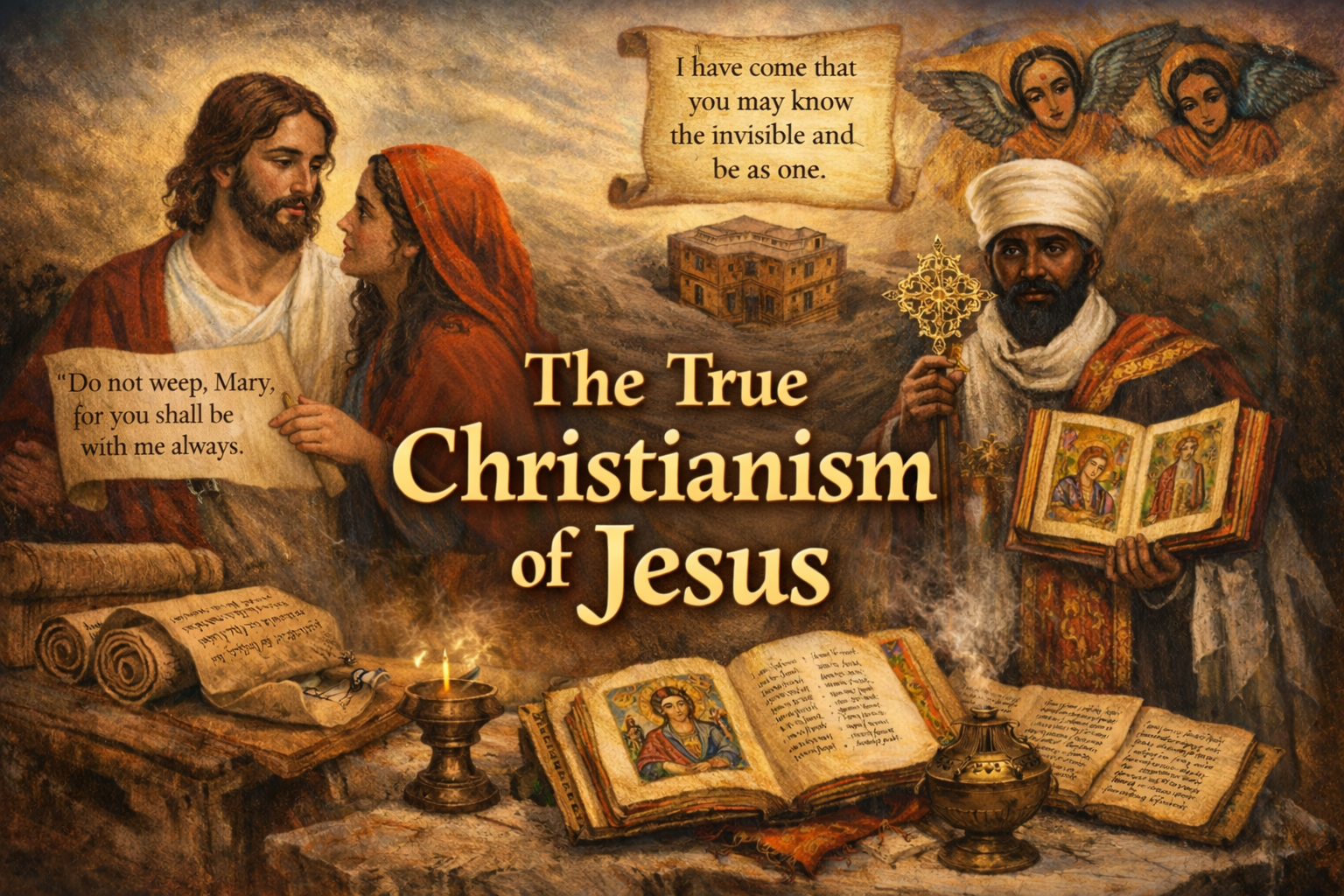
The Bible Discovered in Ethiopia:
Early Christianity
References to Ethiopian texts studied from 2023 onward
(a manuscript tradition recently made accessible and translated into English)
In one of these Ethiopian manuscripts, Jesus says:
“The kingdom you seek will not come with armies or thrones.
It is hidden within you, waiting to be recognized.”
There is also a warning:
“After I depart, some will speak in my name without having understood my words.
They will turn into ritual what I gave as living spirit.
They will build temples when I taught you that every heart is a temple.”
Introductory summary:
This article explores one of the oldest and least-known memories of Christianity: the biblical and manuscript tradition preserved in Ethiopia. Drawing on Ethiopian texts studied and translated recently (since 2023)—together with non-canonical gospels discovered in the twentieth century, such as Thomas and Mary—an early Christianity emerges that is more diverse, mystical, and contemplative than the form that ultimately prevailed in the West.
These texts do not deny known history, but they shift the emphasis: from sin understood as inherited guilt to ignorance understood as forgetting; from salvation as payment to salvation as awakening; from external authority to inner transformation. Within them echoes a central teaching attributed to Jesus—present both within and beyond the canon: “The Kingdom of God is within you.”
The Ethiopian tradition, with a broader biblical canon and a development less subject to Roman imperial power, preserved texts and approaches that were marginalized in other contexts. Read alongside discoveries such as the Dead Sea Scrolls or Nag Hammadi, these manuscripts do not form a closed alternative doctrine, but a coherent thread of early Christianity that invites less belief and more remembering, awakening, and understanding.
This is not an attempt to rewrite the faith, but to broaden the perspective: to understand that Christianity in its first centuries was plural, living, and deeply spiritual—and that some of its most transformative voices survived far from the center of the Empire, kept in silence for centuries.
Books Worth Reading:
Recommended readings to further explore the topics presented in this article:
https://constelacionesfamiliares.es/books
1. The Ethiopian biblical canon
When it is said that Ethiopia’s biblical canon is broader than the Western one, this is neither a metaphor nor a theological opinion: it is a documented fact.
The Ethiopian Orthodox Tewahedo Church recognizes 81 books, compared to:
-
66 books in the Protestant canon,
-
73 books in the Catholic canon,
-
and a slightly different number in the Eastern Orthodox churches.
2. The Bible was not a closed block from the beginning
The Ethiopian canon preserves a broader snapshot of ancient Christianity, from before the definitive fixation of the Roman canon.
3. Less emphasis on inherited guilt
Although the Ethiopian Church is not “anti-dogmatic,” its canon does not reflect an obsession with original sin as guilt. Instead, it focuses its attention on ignorance, disorder, and restoration.
This textual atmosphere allows readings of salvation that are more transformative than punitive.
4. Continuity with other modern discoveries
What Ethiopia preserved is not an isolated anomaly. Many of its texts:
-
also appear among the Dead Sea Scrolls,
-
reemerge at Nag Hammadi (twentieth century),
-
or are cited by early Church Fathers before being excluded.
In other words, Ethiopia did not “invent” these texts; it preserved them.
The texts of Ethiopia are not marginal fragments of Christianity, but one of its oldest and best-preserved memories—witness to a faith that developed before full institutionalization and that preserved a spiritual diversity progressively silenced in other historical contexts.
For centuries, while Christianity was consolidating in the Roman Empire through councils, creeds, and hierarchies, a deeply monastic, contemplative form of faith developed in the highlands of the Horn of Africa, relatively independent of imperial power.
Historically, we know that Christianity arrived early in Ethiopia. The Book of Acts mentions the Ethiopian official baptized by Philip. And we know that the Kingdom of Aksum officially adopted Christianity in the fourth century, before Rome made it the religion of the state.
That fact matters, because when a faith becomes an empire, diversity ceases to be a richness and becomes a problem. Unity becomes a necessity. Orthodoxy stops being merely an interpretation and becomes a norm.
There is no need to imagine modern conspiracies. It is enough to understand how institutions work: what cannot be controlled is marginalized.
For the early “Fathers” of the Church, this was ungovernable. A decentralized, mystical Christianity could not be organized by imperial decree. Thus, these teachings were marginalized, condemned, or forgotten—except in places like Ethiopia, where no emperor’s hand could reach.
Jesus speaks to the heart, not to hierarchy. He does not demand worship, but remembrance.
Yet in the Christianity of the Roman Empire, Jesus’ messages were lethal to institutions. If you do not need a mediator between your soul and God, the entire imperial structure collapses.
The Ethiopian Church developed at a different rhythm: silence, fasting, inner prayer. And with a verifiable fact: its biblical canon is broader than the Western one. This forces us to acknowledge something uncomfortable: the Bible was a process, not a closed block from the beginning.
In the early centuries, many forms of Christianity coexisted:
Some centered on sacrifice.
Others on wisdom.
Some on obedience.
Others on inner awakening.
Ethiopia did not see itself as Christianity’s periphery, but as its spiritual heart—the guardian of divine memory.
And here a common axis appears, present in both canonical texts and parallel mystical traditions:
“The Kingdom is within you.”
The Kingdom of God is not a future place; it is a reality to be recognized.
1. The Kingdom within — Gospel of Luke / Gospel of Thomas
In the biblical canon (Luke 17:21), Jesus says:
“The Kingdom of God does not come with observable signs.
Nor will people say, ‘Here it is,’ or ‘There it is.’
For the Kingdom of God is within you.”
This phrase is canonical. But in the Gospel of Thomas (discovered at Nag Hammadi in 1945, Coptic, fourth century, with earlier tradition), this idea becomes central and explicit:
“The Kingdom is inside you and outside you.
When you know yourselves, then you will be known.”
This is not a historical text in the modern sense, but it is an early witness to a real mystical Christian current that predates doctrinal standardization.
2. Dialogues of the inner Kingdom — Ethiopian texts
(preserved tradition, translations 2023)
In Ethiopian manuscripts preserved in monasteries—some studied and translated recently (2023)—dialogues appear that develop this same teaching narratively.
They are not presented as canonical gospels, but as spiritual teaching texts, coherent with Eastern Christian mysticism.
In one of these dialogues, Jesus says:
“The kingdom you seek will not come with armies or thrones.
It is hidden within you, waiting to be recognized.”
When a disciple asks:
“Master, how will the world know that the Kingdom has come?”
Jesus responds:
“It will not know through signs.
It will know when the human being awakens to the light that already dwells within.”
These words reflect a spiritual line documented across multiple early Christian traditions.
3. Mary Magdalene — Gospel of Mary / Gnostic texts
In the Gospel of Mary (discovered in 1896 and expanded with Nag Hammadi), Mary Magdalene appears as a close disciple who understands profound teachings and dialogues with Jesus.
In that text, Mary asks questions others do not dare to ask and is recognized for her understanding.
In the preserved Ethiopian texts, this image reappears coherently.
Mary Magdalene asks:
“Master, you speak of a Kingdom that is within, but the prophets spoke of a Kingdom that would come.
How can both be true?”
Jesus responds (in line with Thomas and Mary):
“The prophets saw the light, but they saw it reflected.
They spoke of forms because they could not yet name the experience.
The Kingdom they glimpsed is not of cities or thrones, but of hearts made luminous.”
From that point on, the text refers to Mary Magdalene as “the one who understands.”
This does not prove that Mary was a universal institutional leader, but it does show that early narratives existed in which spiritual authority depended not on gender, but on understanding.
4. The cross — Mystical Christian tradition / parallel texts
In later Western theology, the cross is interpreted as substitutionary sacrifice.
In mystical Christian texts—Thomas, some Ethiopian writings, and related traditions—the cross is reinterpreted.
Jesus says (in these texts):
“I do not suffer so that you may not suffer.
I suffer to show you that suffering, when passed through with awareness, becomes understanding.”
When a disciple asks:
“If you carry our burden, what remains for us?”
Jesus responds:
“You must still carry your own cross.
The cross is not wood.
It is the place where pain meets understanding.”
This vision does not deny the historical crucifixion, but shifts its meaning:
salvation as awakening, not as payment of a debt.
5. Sin as forgetting — Judeo-Christian mystical tradition
In several non-canonical texts and early mystical commentaries, “sin” is not defined as inherited guilt, but as ignorance or forgetting.
In the Ethiopian texts it is expressed as:
“There is no sin but forgetting.
There is no fall but sleep.
Awaken, and you will see that you were never cast out of Paradise.”
This idea finds parallels in:
-
early Jewish mysticism,
-
Gnostic currents,
-
and desert texts preserved outside the Roman canon.
6. A warning from Jesus — Ethiopian texts / prophetic tradition
In Ethiopian manuscripts there also appears a warning attributed to Jesus:
“After I depart, some will speak in my name without having understood my words.
They will turn into ritual what I gave as living spirit.
They will build temples when I taught you that every heart is a temple.”
This warning resonates strikingly with the later evolution of Christianity.
7. What we can affirm
That early Christianity was diverse;
that early mystical currents existed;
that some texts were preserved outside the imperial axis;
and that Ethiopia conserved a distinct memory.
The question these texts raise is not historical, but existential:
What if the central message was not only to believe, but to awaken?
What if faith is not a transaction, but a transformation?
What if the Kingdom is not later, but now?
These questions do not destroy tradition.
They make it broader.
More honest.
More alive.
Dialogues preserved in the ancient Christian mystical tradition
(Thomas · Mary · Ethiopian texts · Eastern tradition)
In one dialogue preserved in this tradition, a disciple asks directly:
A disciple asks:
“Why do we need your teaching?”
Jesus answers:
“You need my teaching because you have forgotten what you are.
My words are not new.
They are the echo of your own soul.”
This dialogue—present directly or resonantly in ancient mystical texts—expresses a central idea: teaching does not introduce something external, but awakens what has been forgotten.
In another passage, the disciples ask about the coming of the Kingdom:
The disciples ask:
“When will the Kingdom come?”
Jesus answers:
“It will not come when you expect it.
It will not be said, ‘Here it is,’ or ‘There it is.’
The Kingdom of the Father is spread out upon the earth, and human beings do not see it.”
(Gospel of Thomas, logion 113 — discovered at Nag Hammadi, 1945)
In the Ethiopian tradition and related dialogues, this teaching appears again:
Jesus says:
“The kingdom you seek will not come with armies or thrones.
It is hidden within you, waiting to be recognized.”
When the disciples ask how the world will know that the Kingdom has come:
A disciple asks:
“Master, how will the world know that the Kingdom has come?”
Jesus answers:
“The world will not know through signs.
It will know when the human being awakens to the light that already dwells within.”
Regarding the deeper identity of the human being, Jesus says:
“When you know yourselves, then you will be known.
And you will understand that you are children of the living Father.
But if you do not know yourselves, you live in poverty, and you are poverty.”
(Gospel of Thomas, logion 3)
In dialogues involving Mary Magdalene, she asks a key question:
Mary says:
“Master, you speak of a Kingdom that is within, but the prophets spoke of a Kingdom that would come.
How can both be true?”
Jesus answers:
“The prophets saw the light, but they saw it reflected.
They spoke of forms because they could not yet name the experience.
The Kingdom they glimpsed is not of thrones or cities, but of hearts made luminous.”
(Gospel of Mary / preserved mystical tradition)
From this exchange onward, Mary is called “the one who understands.”
Regarding suffering and the cross, Jesus teaches:
“I do not suffer so that you may not suffer.
I suffer to show you that suffering, when passed through with awareness, becomes understanding.”
And when a disciple asks:
A disciple asks:
“If you carry our burden, what remains for us?”
Jesus answers:
“You must still carry your own cross.
For the cross is not wood.
It is the place where pain meets understanding.”
On sin and salvation, mystical texts express:
Jesus says:
“There is no sin but forgetting.
There is no fall but sleep.
Awaken, and you will see that you were never cast out of Paradise.”
One passage describes the practice:
“When you withdraw into silence and seek the light within, you will find it there.
When I said ‘you are the light of the world,’ I spoke truth.”
Here, “kingdom” also carries the meaning of sovereignty—the sovereignty within.
Another dialogue confronts messianic expectations:
“We have been taught that the Kingdom comes when the Messiah defeats the enemies of Israel.”
Jesus answers:
“The Messiah you await is not a king with armies, but a consciousness that awakens in every heart.”
Every soul is a temple. Every breath is prayer.
And finally, a warning attributed to Jesus appears, preserved in Ethiopian texts and parallel traditions:
“After I depart, some will speak in my name without having understood my words.
They will turn into ritual what I gave as living spirit.
They will build temples when I taught you that every heart is a temple.”
These dialogues do not attempt to reconstruct word for word what Jesus historically said, but to preserve the spiritual memory of an early Christian current: a teaching centered on awakening, remembrance, and inner transformation.
Read together—Thomas, Mary, Ethiopian texts, and other twentieth-century discoveries—they do not form a closed alternative doctrine, but a coherent thread running through early Christianity that invites less belief and more remembrance of who we are.
@AngelPrimal
RELATED VIDEO:
Jesus Didn’t Die for Sin? The Ethiopian Bible Says NO! (The Church Hid It)
https://youtu.be/LmqrrENyBAQ?si=NS2FLs-uG0gH2kG6
Directorio de Artículos – Directory of Articles
@AngelPrimal
https://angelprimal.com/dir