
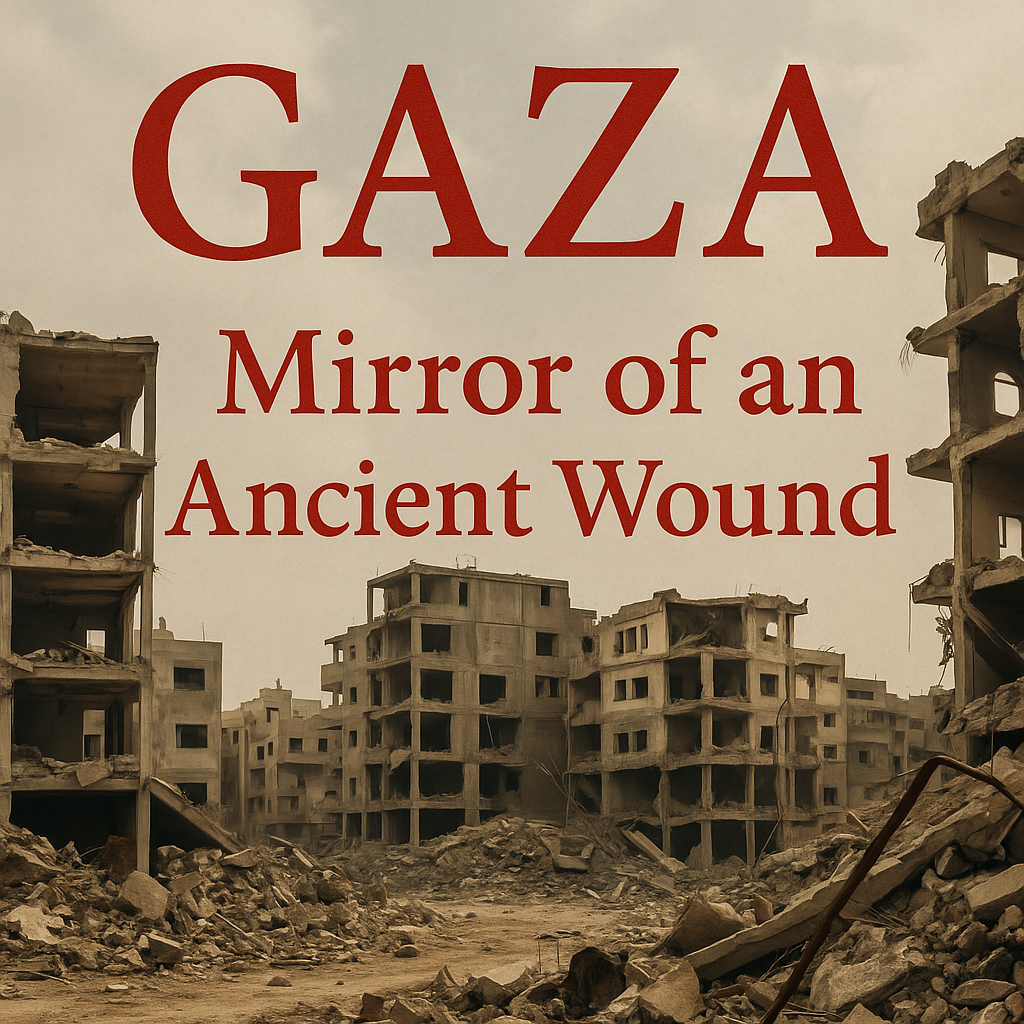
Gaza: Mirror of an Ancient Wound — From the Dream of the Chosen People to the Eternal Conflict
Artículos relacionados: Creación de las Religiones Abrahámicas – Creando el Cristianismo – Creando el Islam – Creando el Judaísmo – El Emperador que Re-escribió la Biblia – Del Dogma Religioso al Dogma Científico – El Cristianismo Suprimido de los Primeros Siglos – Similitudes en la Creación de las 3 Religiones Abrahámicas –
Note: We have been indoctrinated to believe that spiritual answers are found only in the so-called sacred books, written centuries ago in contexts very different from our own. However, we often forget that divinity continues to manifest in every era, sending the teachers of freedom and love that humanity needs at each moment. Among the living teachers who most inspire and move me are Mooji and Peter Crone (also Gangaji, Eckhart Tolle, Byron Katie, Teal Swan, and others).
Introduction
In Gaza, the bombs not only destroy buildings and extinguish thousands of innocent lives: they reveal the oldest disease of the human soul.
The memory of pain, when it does not transform into awareness, becomes a weapon.
It is not the descendants of the Jewish people who are repeating the oppressor’s script, but disconnected beings—driven by ambition and the thirst for power—who usurp the narrative of a people’s suffering to justify their actions.
They have turned the sacred memory of suffering into a political shield, collective trauma into symbolic capital, and history into an alibi.
The ancestral lament of the Jewish people—who once cried out never to be enslaved again—has, in the hands of usurpers, become a machinery that represses and enslaves others.
Unhealed trauma turns into ideology; the wound becomes a flag; and memory, an instrument of mass manipulation.
The minds of today’s Zionist leaders, blinded by their own disconnection from the heart, do not seek to heal but to dominate, subdue, and crush.
In their name, Jewish prophecies are invoked, supposed borders from thousands of years ago are redrawn, and the eternal cycle of executioner and victim is repeated—this time managed by the alleged heirs.
For when the word “God” is used to justify borders, wars, or privilege,
the original message—liberating and universal—
is buried beneath the rubble of history.
Gaza as the Mirror of an Ancient Wound
The suffering unfolding today in Gaza is not merely a political tragedy or a territorial conflict; it is the contemporary reflection of a millennia-old spiritual wound.
In every bomb, in every child beneath the rubble, echoes the story of something much older: an ideal that once spoke of freedom, justice, and communion—now hijacked by interests that betray it.
Gaza is, in a sense, the mirror in which the shadow of monotheism is reflected.
In its origins, the message was pure: one God, invisible, present in all things.
But over the centuries, that light became tainted with politics, identity, and fear.
The inner God became a flag; the spiritual covenant turned into a national contract; and the “Promised Land” shifted from being a metaphor of the soul to a frontier defended by fire.
The cycle seems endless.
Those who invoke the memory of the chosen people find themselves, through the gears of modern power, repeating the same dynamics of domination they once condemned.
Spirituality empties out, faith is instrumentalized, and myth becomes a weapon of legitimation.
But where does this myth come from?
At what moment did a spiritual vision of freedom transform into a structure of control?
And who wrote the story that continues to shape the fate of the world today?
Historical Burrow: Who Really Wrote the Story of Moses (and Why)?
The figure of Moses is the axis of the entire Jewish narrative—
liberator, prophet, lawgiver, mediator between God and man.
Without him, Judaism would lack its foundation, Christianity its precedent, and Islam its prophetic genealogy.
And yet, the question that unsettles modern scholars remains:
Did Moses really exist, or was he a literary and political creation?
The Absence of the Historical Moses
Egypt, the setting for the foundational events of the Exodus, was a civilization obsessed with recording its history: wars, contracts, dreams, taxes, births—nothing escaped the temple archives.
Yet there is not a single mention of the Exodus in their texts.
No plagues, no enslaved people called “Hebrews,” no army drowned in the sea.
The silence of Egyptian sources is no small detail—it is an abyss.
And it forces us to reconsider the nature of the Mosaic narrative:
more than a biography, it appears to be a political mythology designed to consolidate a national identity.
The biblical chronologies also fail to align with the Egyptian reigns proposed by tradition.
The numbers of the Exodus—hundreds of thousands of Hebrews wandering the desert—are impossible demographically and logistically.
There is no archaeological evidence of such a mass migration.
Thus, the historical Moses fades away.
And what emerges is something deeper: a symbolic construction meant to give coherence to the collective memory of a scattered people.
The Documentary Hypothesis: A Moses of Many Hands
The Bible itself reveals its inner diversity.
Modern literary studies have identified four main sources in the Pentateuch, each with distinct style, theology, and purpose:
-
Yahwist (J) – written in the kingdom of Judah (10th century BCE): depicts a close, almost human God.
-
Elohistic (E) – from the northern kingdom (9th century BCE): presents a transcendent God who communicates through dreams and visions.
-
Deuteronomist (D) – written during the Babylonian exile (7th–6th century BCE): interprets history as punishment or reward depending on faithfulness to the covenant.
-
Priestly (P) – post-exilic: obsessed with purity, rituals, and genealogy; transforms Moses into a ritual legislator and founder of worship.
These currents were not erased but woven together into a single narrative.
The final Moses is a composite figure, adapted to multiple political and spiritual contexts.
Each version responded to a different crisis: loss of territory, exile, foreign threat, moral disintegration.
Moses was, ultimately, the symbolic response to a people’s fragility.
The Purpose of the Mosaic Myth
The Mosaic story fulfills essential functions:
-
Unifies scattered tribes under a common story of origin and destiny.
-
Legitimizes the law: what Moses dictates is not human but divine.
-
Consolidates national identity around the covenant with Yahweh.
-
Justifies territorial rights as divine promise, not conquest.
-
Reinterprets suffering as trial, not abandonment.
The genius of the myth lies not in its historicity but in its psychological power:
it transforms vulnerability into purpose, trauma into mission, and exile into spiritual testing.
The Final Redaction: A Narrative Engineering of Survival
During the Babylonian exile, when the temple was destroyed and the people dispersed, the priests realized something crucial: if they could not preserve a sacred place, they had to turn the text into the temple.
Power no longer resided in territory but in writing.
The Ark of the Covenant moved from the desert to the parchment.
And Moses, more than a dead leader, became an eternal voice inscribed in words.
The Bible thus became an act of cultural resistance:
to unify stories, fuse traditions, and create a narrative so powerful that no empire could erase it.
This strategy worked.
Judaism survived Babylon, Rome, and the Diaspora, and it endures today because its center is not geographical but textual.
The letter became the homeland.
The Reverse of the Myth: From Covenant to Border
But this same strength holds a trap.
When the covenant is interpreted literally—“we are the chosen people; this land belongs to us by divine decree”—the myth becomes ideology.
And that ideology, in the hands of those who seek power and control, becomes a sacred justification for violence.
The God who once liberated from Egypt becomes the guardian of walls.
The inner promise becomes territorial property.
The memory of suffering becomes a license to inflict it.
Gaza is the most visible consequence of that distortion:
a land where spirituality is used as the language of war and history as a manual of domination.
The myth that once sustained the hope of the oppressed is now the shield of the oppressor.
Conclusion: From Myth to Awakening
The myth of Moses should not be judged by its archaeological truth but by its symbolic potency.
Its miracle was not the parting of the waters but the preservation of the idea of liberation.
But when the myth’s spiritual nature is forgotten, it becomes a weapon.
And when the word “God” is used to justify borders, wars, or privileges,
the original message—liberating and universal—
is buried beneath the rubble of history.
The true exodus we face today is leaving the mental Egypt:
abandoning the gods of fear, nationalism, and imposed identity.
Crossing the inner sea that separates self from other.
And discovering, at the end of the journey, that the Promised Land is not beyond the wall,
but within the reconciled heart of humanity.