Revelaciones del Concilio de Nicea y los Evangelios Perdidos
Artículos relacionados: Creación de las Religiones Abrahámicas – Creando el Cristianismo – Creando el Islam – Creando el Judaísmo – El Emperador que Re-escribió la Biblia – Del Dogma Religioso al Dogma Científico – El Cristianismo Suprimido de los Primeros Siglos – Similitudes en la Creación de las 3 Religiones Abrahámicas
Nota: Hemos sido adoctrinados para creer que las respuestas espirituales se encuentran únicamente en los llamados libros sagrados, escritos hace siglos en contextos muy distintos al nuestro. Sin embargo, a menudo olvidamos que la divinidad sigue manifestándose en cada época, enviando a los maestros de la libertad y del amor que la humanidad necesita en cada momento. Entre los maestros vivos que más me inspiran y me encantan se encuentran Mooji y Peter Crone( (También Gangagi. Eckhart Tolle, Byron Kartie, Teal Swan y otros)
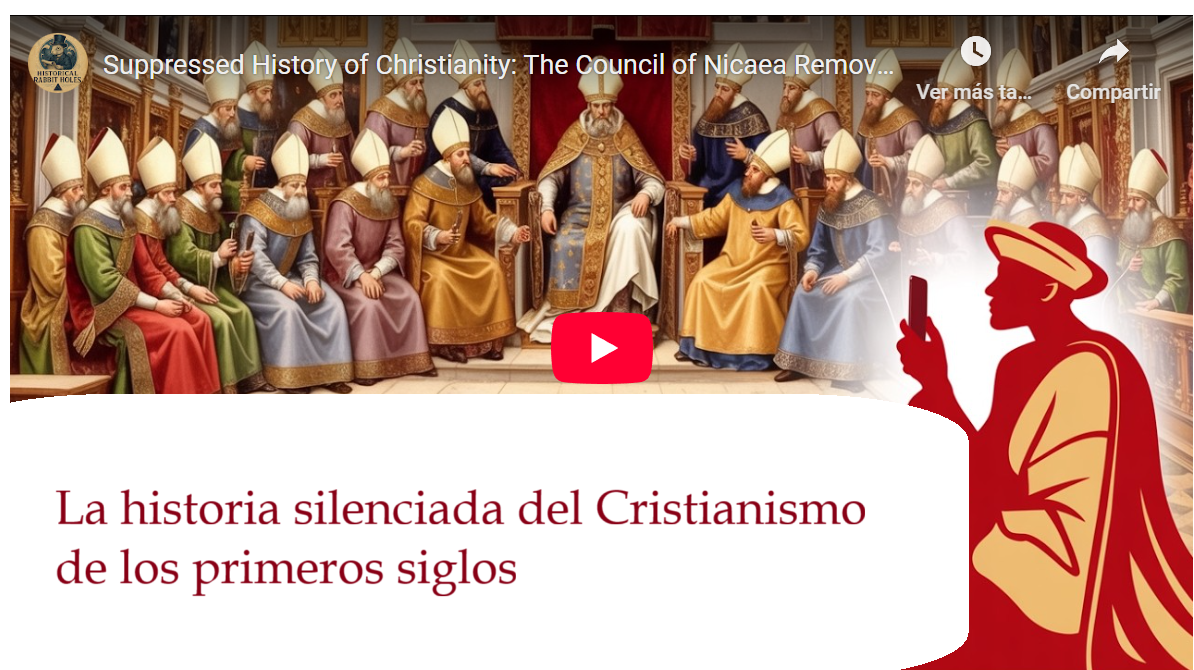
Suppressed History of Christianity: The Council of Nicaea Removed Books That Change Everything
La Historia Silenciada del Cristianismo: Revelaciones del Concilio de Nicea y los Evangelios Perdidos
Le preguntaron al maestro: «¿Cual es la diferencia entre la Realidad y la Ficción?»
El maestro contestó: «La Ficción tiene que tener sentido»
Resumen en Castellano (≈3.000 palabras)
En el año 325 d.C., en una pequeña ciudad llamada Nicea —en la actual Turquía— ocurrió un acontecimiento que transformaría para siempre el destino espiritual y político de Occidente. Cientos de obispos, venidos de las regiones más remotas del Imperio Romano, atravesaron tierras peligrosas para reunirse convocados por el emperador Constantino. No solo cargaban equipajes: llevaban consigo distintas visiones de Cristo, diferentes textos y evangelios, doctrinas opuestas y una inmensa diversidad de comunidades cristianas. Aquella diversidad hoy resulta casi inimaginable. Antes de Nicea no existía “un” cristianismo, sino “muchos” cristianismos.
Algunos veían a Jesús como un ser divino desde su nacimiento; otros, como un hombre que alcanzó la divinidad; y otros, como un maestro iluminado, distinto de Dios Padre. Los escritos sagrados eran numerosos y variopintos: Evangelio de Tomás, Evangelio de María Magdalena, Evangelio de Felipe, Evangelio de la Verdad y decenas más circulaban y eran venerados como auténticas escrituras en comunidades establecidas. Muchos de estos textos mostraban un rostro de Jesús muy diferente al canon posterior: un maestro de sabiduría interior, un transmisor de conocimiento secreto, un guía hacia la transformación espiritual directa, más que un salvador sacrificial.
El Concilio de Nicea no fue simplemente una asamblea teológica. Fue, ante todo, un movimiento político. Constantino, convertido al cristianismo, comprendió que un Imperio dividido en sectas rivales era un Imperio débil. Necesitaba una versión única del cristianismo que uniera, no que fragmentara. Así, el concilio se convirtió en un escenario donde la teología y el poder se entrelazaron. Los obispos no eran solo pastores del espíritu; eran representantes de facciones, regiones y textos concretos. De ese forcejeo surgió el canon y, con él, el inicio de una purga literaria que silenció voces, destruyó libros y uniformó la fe.
El Precio de la Unidad: Supresión y Pérdida
¿Por qué solo quedaron 27 libros en el Nuevo Testamento, mientras cientos desaparecieron? Porque se eligieron los que fortalecían la jerarquía, el dogma y la autoridad eclesial. Textos como el Evangelio de Tomás, que enseñaba “el Reino de Dios está dentro y fuera de vosotros” y que “quien encuentre el sentido de estas palabras no experimentará la muerte”, eran peligrosos. Peligrosos no por falsedad, sino porque convertían la salvación en un camino interior, sin intermediarios. Si cada persona podía acceder al “conocimiento divino” directamente, ¿para qué sacerdotes, obispos y estructuras de poder?
Los evangelios que exaltaban a María Magdalena como discípula predilecta o que sugerían prácticas espirituales avanzadas —misterios, uniones sagradas, niveles de iniciación— eran subversivos para una Iglesia en construcción jerárquica y masculina. El cristianismo oficial necesitaba un Cristo único, sacrificial, mediado por la institución y por credos rígidos. Necesitaba también relegar a las mujeres y excluir cualquier enseñanza que disolviera las fronteras entre lo humano y lo divino.
Así, se etiquetó de “herético” lo que no encajaba en la nueva ortodoxia. Se dejó de copiar estos libros, se destruyeron bibliotecas, se persiguió a sus lectores y maestros. La diversidad cristiana se extinguió gradualmente. Lo que se impuso no fue necesariamente lo más antiguo ni lo más auténtico, sino lo más útil para el poder imperial.
Los Textos Ocultos: Un Tesoro del Desierto
Pero la supresión no fue total. Algunos monjes y comunidades escondieron los textos condenados. En 1945, en Nag Hammadi (Egipto), campesinos hallaron 13 códices de cuero sellados en vasijas de barro: más de 50 evangelios y tratados gnósticos, intactos desde hacía 1500 años. Eran, literalmente, cápsulas del tiempo. Por primera vez desde el siglo IV, los estudiosos pudieron leer el Evangelio de Tomás, de Felipe, de la Verdad, y comprender que el cristianismo primitivo fue mucho más místico, plural y filosóficamente sofisticado de lo que la historia oficial relató.
Estos textos no solo ofrecen datos históricos. Son manuales espirituales. Enseñan métodos de autoconocimiento, describen estados de conciencia y prácticas que hoy llamaríamos meditativas o iniciáticas. Hablan de “resurrección” no como un evento futuro ni un dogma, sino como una experiencia interior que debe suceder en vida: “Si no recibes la resurrección mientras vives, cuando mueras no recibirás nada”. Presentan el “Reino” no como premio postmortem, sino como realidad presente accesible a través del despertar interior.
Cristianismo Místico vs. Cristianismo Institucional
El contraste entre los textos canónicos y los suprimidos es radical. El primero ofrece una religión de fe, creencias y obediencia. El segundo, un camino de experiencia directa, integración interior y descubrimiento de la divinidad en uno mismo. En lugar de seres humanos caídos que necesitan un salvador externo, los textos gnósticos ven a cada persona como portadora de una chispa divina que debe recordar su origen. Esta diferencia no es menor; es un cambio de antropología y de cosmovisión.
Los excluidos también presentan una imagen distinta de Jesús. No como una figura única e irrepetible, sino como un maestro que encarnó una conciencia universal a la que todos podemos acceder. Enseña: “Si traes a la luz lo que está en ti, eso te salvará”. Es un mensaje de empoderamiento espiritual imposible de monopolizar por una institución. Por eso, más que heterodoxos, estos textos fueron peligrosos. Hacían inviable el proyecto de Constantino y de los obispos: un cristianismo homogéneo al servicio del Imperio.
Ecos de una Tradición Silenciada
Pese a siglos de persecución, este cristianismo místico no desapareció del todo. Afloró en corrientes marginales: los cátaros en la Edad Media, los místicos renanos como Meister Eckhart, los hesicastas en Oriente, los reformadores espirituales del Renacimiento. Todos ellos, sin acceso directo a los textos perdidos, redescubrieron por intuición parte de esa sabiduría: la divinidad interior, la unión con Dios más allá de dogmas, la práctica contemplativa como camino. Por ello fueron vigilados, censurados, a veces exterminados.
El hallazgo de Nag Hammadi y los Rollos del Mar Muerto en el siglo XX cambió el panorama. Mostró que lo que se consideraba herejía tardía era en realidad herencia primitiva. Que la uniformidad no fue origen, sino resultado de un proceso de selección política. Que la verdadera riqueza del cristianismo no está solo en sus credos, sino en su pluralidad original y en su núcleo místico universal.
Implicaciones Filosóficas y Espirituales
Este descubrimiento plantea preguntas profundas. ¿Y si la versión del cristianismo que heredamos no es la original, sino una construcción imperial? ¿Y si los textos suprimidos preservan enseñanzas más cercanas a lo que Jesús realmente transmitió? ¿Cómo sería Occidente si aquel cristianismo experiencial, igualitario y consciente hubiese prosperado en lugar del dogmático? Tal vez habría surgido una cultura más inclusiva, con menos guerras religiosas, con puentes entre ciencia y espiritualidad, con métodos avanzados de autodesarrollo en lugar de disputas sobre doctrinas.
Estos evangelios no son solo reliquias. Son espejos que nos invitan a reimaginar la espiritualidad. Nos muestran un cristianismo donde el Reino es “aquí y ahora”, donde la resurrección es un estado de conciencia, donde las mujeres lideran y enseñan, donde la divinidad es inmanente y no propiedad exclusiva de un clero. Son textos tan revolucionarios hoy como lo fueron en el siglo IV. Y eso explica por qué fueron ocultados.
Del Pasado al Presente: Una Invitación al Despertar
Lo más sorprendente es que este legado reaparece justo cuando millones buscan alternativas a la religión institucional o al vacío del materialismo. En un mundo en crisis, los textos suprimidos ofrecen prácticas probadas para cultivar conciencia, compasión y creatividad. Son guías de transformación, no solo credos. Nos recuerdan que la verdadera “Buena Nueva” no es creer en algo, sino despertar a lo que ya somos.
El Concilio de Nicea logró su propósito político: una Iglesia unificada que sostuvo un Imperio y luego moldeó la civilización europea. Pero fracasó en erradicar las verdades más profundas que Jesús enseñó a sus discípulos. Esas verdades sobrevivieron selladas en barro, esperando el momento de resurgir. Ese momento parece ser ahora. La pregunta ya no es histórica, sino personal: ¿qué haremos con este conocimiento? ¿Lo reduciremos a curiosidad académica o lo aplicaremos como camino de transformación?
Conclusión: La Otra Cara del Cristianismo
La historia suprimida del cristianismo nos revela el que quizá sea el mayor silenciamiento de información espiritual en Occidente. Un silenciamiento que no solo borró libros, sino que modeló la forma misma en que entendemos lo divino, la autoridad religiosa y nuestro propio potencial. Redescubrir estos textos es más que corregir la historia. Es recuperar un mapa perdido de la conciencia humana. Es volver a escuchar la voz de un Jesús maestro, no solo objeto de culto. Es recordar que el “Reino” del que habló no es un premio futuro, sino una realidad presente que cada uno puede experimentar.
Lo que se suprimió en Nicea no fue simplemente teología alternativa. Fue un camino entero de despertar espiritual, de acceso directo a la divinidad, de dignidad compartida entre hombres y mujeres, de unión entre fe y experiencia. Y esa sabiduría, oculta durante siglos, hoy nos desafía a mirar más allá de los dogmas y a emprender el viaje interior que estos evangelios proponen.
La decisión está en nuestras manos: aceptar la versión limitada nacida del poder imperial o explorar el horizonte inmenso que estos textos nos devuelven. Porque lo que está en juego no es solo cómo entendemos el cristianismo, sino cómo entendemos la vida, la conciencia y la posibilidad de ser plenamente humanos.
Suppressed History of Christianity: The Council of Nicaea Removed Books That Change Everything
ENGLISH TRANSCRIPTION OF THE VIDEO
suppressed history of Christianity. The Council of Nika removed books that change everything. The year was 325 AD and something extraordinary was about to happen in a small town called Nika, nestled in what we now call Turkey. Picture this. Hundreds of bishops from across the Roman Empire, traveling for weeks through dangerous territories, all converging on one location.
They carried with them not just their personal belongings, but something far more precious and controversial. Different versions of Christian texts, different interpretations of faith, and radically different ideas about what Christianity should actually be. What most people don’t realize is that before this council, Christianity wasn’t the unified religion we recognize today.
It was a collection of diverse communities, each with their own sacred writings, their own understanding of Jesus and their own practices. Some believed Jesus was divine from birth. Others saw him as a man who became divine, and still others viewed him as entirely separate from God the Father.
The variety was staggering, and so was the collection of texts they considered sacred. But here’s where the story takes a turn that most history books gloss over or ignore entirely. What happened at Nika wasn’t just a peaceful theological discussion. It was a calculated political move that would reshape Christianity forever.
And in the process, certain books, books that painted a very different picture of early Christian beliefs, were systematically removed, hidden, or destroyed. Today, we’re going to uncover what really happened behind those closed doors in Nika. We’re going to explore the books that were deemed too dangerous for ordinary Christians to read. And we’re going to discover how this single event fundamentally altered the trajectory of one of the world’s largest religions.
Because what you think you know about early Christianity, it’s only part of the story. Let me start with something that might shock you. The idea that there were originally four gospels, Matthew, Mark, Luke, and John, and that these were always considered the definitive accounts of Jesus’s life, that’s not historically accurate. Before Nika, Christian communities were using dozens of different gospels, acts, letters, and apocalyptic writings.
There was the Gospel of Thomas, filled with mysterious sayings of Jesus. The Gospel of Mary, which portrayed Mary Magdalene as one of Jesus’s most trusted disciples. The Gospel of Philip, which suggested a much more intimate relationship between Jesus and Mary than traditional Christianity teachers. These weren’t fringe documents written by heretics.
They were cherished scriptures used by established Christian communities across the Mediterranean world. Archaeological discoveries in the 20th century, particularly at Nag Hammadi in Egypt, have revealed just how extensive this early Christian library actually was.
We’re talking about over 50 different gospels and hundreds of other Christian writings that were in circulation before Na. So what changed? Why did we end up with just 27 books in the New Testament while hundreds of others vanished from Christian consciousness? The answer lies in understanding who called the Council of Nika and why. Emperor Constantine, who had recently converted to Christianity, found himself ruling over an empire where Christians were fighting amongst themselves with an intensity that threatens civil stability.
The most heated debate centered around a priest named Aras from Alexandria who taught that Jesus, while important and divine, was still subordinate to God the Father. This directly contradicted the growing belief that Jesus was co-eternal and equal with God. But here’s what’s fascinating and what most people miss. Constantine wasn’t primarily interested in theological correctness.
He was interested in political unity. A fractured Christianity meant a fractured empire. He needed one version of Christianity that everyone could agree on. And he needed it fast. The bishops who gathered at Nika weren’t just theologians debating abstract concepts. They were political actors representing different factions, different regions, and different collections of sacred texts.
Each group arrived with their preferred books, their preferred interpretations, and their preferred version of what Christianity should become. The process of determining which books would be considered canonical, meaning officially accepted as authentic scripture was far more contentious and political than most Christians realize today.
It wasn’t simply a matter of divine inspiration or obvious authenticity. It was about power, influence, and whose version of Christianity would dominate. Consider the Gospel of Thomas, for example. This text presents Jesus not as a sacrificial savior dying for humanity’s sins, but as a wisdom teacher, revealing hidden knowledge to those prepared to understand it.
Instead of emphasizing faith and belief, it focuses on direct spiritual experience and inner awakening. The very first saying in this gospel reads, «Whoever finds the interpretation of these sayings will not experience death.» This is radically different from the message of salvation through faith alone that would later become central to Orthodox Christianity.
Or take the Gospel of Mary Magdalene, which portrays her not as a reformed prostitute, a characterization that actually appears nowhere in the canonical gospels, but as Jesus’s most spiritually advanced disciple, someone to whom he revealed teachings he didn’t share with the male apostles.
In this text, Peter and the other male disciples are actually jealous of Mary’s special relationship with Jesus and her deeper understanding of his teachings. These books presented versions of Christianity that were more mystical, more egalitarian toward women, and less focused on institutional authority.
They suggested that salvation came through knowledge and direct spiritual experience rather than through belief in specific doctrines or submission to church hierarchy. You can imagine how threatening these ideas were to bishops who were trying to establish a unified hierarchical church structure. If everyone could have direct access to divine knowledge as the Gospel of Thomas suggested, then what was the need for priests, bishops, and elaborate church institutions? If women like Mary Magdalene were portrayed as spiritually equal or even superior to the male apostles, as several of these texts indicated, then
how could the emerging church justify excluding women from leadership positions? The political calculations were clear. Constantine and the bishops supporting the emerging Orthodox position needed texts that emphasized unity, hierarchy, and the authority of church leaders. They needed a version of Christianity that could serve as a unifying force for the empire, not one that encouraged individual spiritual seeking or challenged established social orders. So when the council of Nika concluded, it wasn’t just theological
questions that had been settled. A massive literary purge had begun. Books that didn’t align with the newly established orthodox position were branded as heretical. Possessing them became dangerous. Copying them became a crime. And gradually, systematically, they began to disappear from Christian consciousness. But here’s where the story gets even more intriguing.
The books that were excluded from the biblical cannon didn’t just disappear overnight. For centuries, copies survived in monasteries, private collections, and hidden libraries. Some Christian communities continued to use them in secret, and occasionally they would surface in ways that threatened to disrupt the official narrative. The process of suppressing these texts required an enormous effort.
Scribes had to be convinced to stop copying them. Libraries had to be purged. Teachers had to be silenced. And gradually over several centuries, the vast majority of these alternative Christian writings vanished from the historical record. What makes this suppression even more significant is that many of these excluded texts actually preserve earlier traditions about Jesus and his teachings than some of the books that made it into the official cannon.
The Gospel of Thomas, for instance, contains sayings of Jesus that many scholars believe are older and more authentic than similar sayings found in Matthew, Mark, Luke, and John. This means that in the process of creating a unified Christianity, some of the earliest and most authentic teachings of Jesus may have been intentionally excluded simply because they didn’t fit the political and theological agenda of the 4th century church leaders.
The implications of this are staggering. It suggests that what we think of as traditional Christianity, the version taught in churches today, may actually be a later development that displaced earlier, potentially more authentic versions of Jesus’s teachings. But the suppression wasn’t complete. Hidden in caves, buried in desert sands, and preserved in forgotten corners of ancient libraries, copies of these excluded books survived.
And in the 20th century, archaeologists began finding them again. The discovery of the Nagamadi Library in 1945 was like finding a lost time capsule of early Christianity. 13 leatherbound codices containing over 50 texts that had been hidden for over 1,500 years suddenly emerged from the Egyptian desert. For the first time since the 4th century, scholars could read the Gospel of Thomas, the Gospel of Philip, the Gospel of Truth, and dozens of other texts that represented the suppressed voices of early Christianity.
What they found challenged almost everything that mainstream Christianity teaches about its own origins. These texts revealed a far more diverse, mystical, and philosophically sophisticated early Christian movement than most people had ever imagined. And this is just the beginning of our investigation because as we dig deeper into what really happened at Nika and why certain books were excluded, we uncover layer after layer of political maneuvering, theological manipulation, and deliberate historical revision that shaped Christianity in ways most
believers never realize. The question we need to ask isn’t just what books were removed, but why they were considered so dangerous that they had to be eliminated entirely. What truths about Jesus, about spirituality, about the nature of religious authority did these texts contain that pose such a threat to the emerging Orthodox Church? The answers to these questions reveal a conspiracy of silence that has persisted for over 16 centuries.
Because what the excluded texts actually taught wasn’t just different from Orthodox Christianity. It was revolutionary in ways that would have fundamentally transformed how we understand spirituality, human potential, and our relationship with the divine. Let’s start with perhaps the most explosive revelation, the concept of divine knowledge being available to everyone.
The Gospel of Thomas opens with a statement that would have terrified church authorities. These are the secret sayings which the living Jesus spoke. Not the dead and resurrected Jesus of Orthodox theology, but the living Jesus, implying his teachings were meant for immediate, direct application rather than distant worship.
This gospel presents over 100 sayings of Jesus that focus almost exclusively on inner transformation and direct spiritual experience. Jesus doesn’t talk about his upcoming death and resurrection. He doesn’t establish church hierarchy or sacraments. Instead, he says things like, «If you bring forth what is within you, what you have will save you.
If you do not have that within you, what you do not have within you will kill you.» This is Christianity as a path of self-discovery rather than submission to external authority. It’s a version of Jesus’s teachings that suggests every person carries within themselves the same divine spark that Jesus embodied. The implications are staggering.
If everyone has access to this inner divinity, then why would you need priests to mediate your relationship with God? Why would you need elaborate church structures or complex theological doctrines? The Gospel of Philip takes this even further, describing advanced spiritual practices and mysteries that were apparently taught only to Jesus’s most prepared disciples.
It speaks of sacred marriages, divine unions, and levels of spiritual initiation that sound more like ancient mystery schools than the simple faith-based religion that Orthodox Christianity became. But perhaps most threatening of all was how these texts portrayed women. The Gospel of Mary doesn’t just show Mary Magdalene as an important disciple. It presents her as Jesus’s most advanced student, someone who received private teachings that even Peter didn’t understand.
When she shares these teachings with the other disciples, Peter responds with jealousy and anger, questioning whether Jesus would really have given a woman teachings he didn’t share with the men. The text records Mary’s response. Do you think that I made this up about the Savior? Do you think I am lying about him? It’s a moment that captures the tension between the emerging maledominated church hierarchy and the more egalitarian spiritual communities that these excluded texts represent.
The Gospel of Philip goes even further, referring to Mary Magdalene as Jesus’s companion and stating that he loved her more than all the other disciples. It describes them kissing frequently which scandalizes the male disciples. Whether this should be interpreted literally or symbolically, it clearly presents a version of Jesus’s story that includes intimate relationships and emotional bonds that the Orthodox Church found impossible to incorporate into their theological framework. These aren’t minor differences in interpretation. These are fundamental
challenges to the entire structure that Christianity would eventually adopt. They present Jesus not as a unique divine being whose death provides salvation for humanity, but as an enlightened teacher, showing others how to access their own divine nature. They portray early Christian communities as including women in leadership roles and advanced spiritual practices rather than simple congregations listening to male priests deliver sermons.
The political implications were clear to Constantine and the bishops at Nika. A Christianity based on these texts would be impossible to control. How do you build an empirewide religious institution around teachings that essentially tell people they don’t need institutions? How do you establish clerical authority when the texts suggest that spiritual insight comes through personal experience rather than theological training? So the solution was elegant and brutal. Declare these texts heretical.
label the communities that use them as dangerous deviants and systematically eliminate them from Christian consciousness. It wasn’t enough to simply choose different books for the official cannon. The excluded texts had to be actively suppressed. Their users persecuted and their very existence erased from memory.
The process took centuries, but it was remarkably thorough. By the time Christianity became the official religion of the Roman Empire under Emperor Theodosius in 380 AD, most Christians had never even heard of these alternative texts. The version of Christianity that survived was the one that best served the political needs of imperial authority.
Hierarchical, doctrinally uniform, and institutionally controlled. But the human cost of this transformation was enormous. Entire Christian communities that had practiced for generations according to these excluded texts found themselves branded as heretics.
Their books were burned, their teachers exiled or executed, and their spiritual traditions driven underground. The rich diversity of early Christian thought and practice was replaced by a single standardized version that borked no alternatives. Consider what we lost in this process. The Gospel of Thomas preserves teachings about the kingdom of heaven that are radically different from orthodox interpretations.
Instead of a future reward for believers, it presents the kingdom as a present reality that can be experienced through spiritual insight. The kingdom is inside of you and it is outside of you. When you come to know yourselves, then you will become known and you will realize that it is you who are the sons of the living father.
This is mystical Christianity at its most profound. A path of direct spiritual realization rather than belief in historical events. It suggests that what Jesus was really teaching was a method for awakening to our own divine nature, not a system of beliefs about his unique divine status. The gospel of truth, another text found at Nagamadi, describes salvation not as something Jesus did for us, but as a form of awakening from ignorance. Those who are to receive teaching are the living who are inscribed in the book
of the living. It is they who receive teaching about themselves. Again, we see Christianity presented as a path of self-nowledge rather than submission to external authority. These texts also preserve a very different understanding of what Jesus’s death actually meant.
Instead of focusing on sacrifice and atonement, the idea that Jesus died to pay for humanity’s sins, many of these excluded writings present his death as a revelation of the elucory nature of physical existence. They suggest that by demonstrating that consciousness survives bodily death, Jesus was teaching about the eternal nature of the human spirit.
This interpretation makes Jesus’s resurrection less about a unique miracle proving his divine status and more about a demonstration of spiritual principles that apply to everyone. It’s a profoundly different theological framework that emphasizes human spiritual potential rather than human sinfulness and dependence on divine intervention. The political ramifications of these different interpretations were obvious to the church leaders at Nika and beyond.
A Christianity that emphasized individual spiritual development, included women in leadership roles, and suggested that divine knowledge was accessible to everyone, would be impossible to use as a tool of imperial control. It would be decentralized, diverse, and ultimately ungovernable.
So, the choice was made to preserve only those texts that supported a hierarchical, institutionally controlled version of Christianity. The Gospel of John with its emphasis on believing in Jesus as the unique son of God was included. The Gospel of Thomas with its emphasis on finding the divine within yourself was excluded. The letters of Paul which established clear church hierarchy and authority structures were preserved.
The Gospel of Mary which showed a woman teaching the male apostles was suppressed. This wasn’t theological scholarship. It was political engineering and the results shaped not just Christianity but western civilization itself because the version of Christianity that emerged from this process wasn’t just a religion.
It became the foundation for medieval European society, the justification for colonial expansion and the framework for understanding human nature and social organization that persisted for over a thousand years. But here’s what makes this historical revision even more troubling. The evidence suggests that many of the excluded texts actually preserve earlier and more authentic traditions about Jesus than some of the books that were included in the official cannon. Scholars who have studied the Gospel of Thomas, for example, have identified
numerous sayings that appear to be older than their parallels in Matthew, Mark, Luke, and John. This means that in their rush to create a politically useful version of Christianity, the church leaders at Nika and beyond may have actually discarded some of the most authentic records of what Jesus actually taught.
They preserved the texts that supported their institutional agenda while suppressing the ones that might have given us a clearer picture of the historical Jesus and his original message. The implications are staggering. What if the Christianity practiced in churches today is actually a later theological development that displaced the original teachings of Jesus? What if the mystical egalitarian experientially based spirituality preserved in the excluded texts is actually closer to what Jesus intended than the beliefbased hierarchically controlled religion that bears his name?
These aren’t just academic questions. They go to the heart of how we understand spirituality, religious authority, and human potential. Because if the excluded texts are right, then the path to spiritual awakening doesn’t require priests, churches, or complex theological doctrines.
It requires looking within, developing direct spiritual experience, and recognizing the divine nature that already exists within each person. And that more than anything else explains why these books had to be suppressed. They represented a form of spiritual empowerment that was incompatible with institutional religious control. They pointed toward a Christianity that couldn’t be monopolized, packaged, or sold by professional clergy.
They preserved a vision of Jesus’s teachings that would have made organized religion as we know it impossible. The tragedy is that this suppression was so successful that for over 1,500 years, most Christians never even knew these alternative texts existed. The rich, diverse, mystical Christianity they represented was almost completely erased from historical memory.
Only now, as archaeologists continue to uncover these lost writings, are we beginning to understand what was really lost in the process of creating Orthodox Christianity. But the story doesn’t end with suppression and loss. Because these texts survived, hidden in desert caves and forgotten libraries, waiting for a time when they could once again challenge our assumptions about Christianity’s origins and true message.
And what they reveal about the nature of spiritual awakening, the role of women in early Christianity, and the original meaning of Jesus’s teachings is far more revolutionary than most people realize. The discovery of these hidden texts didn’t just happen by accident. In 1945, near the town of Nag Hammedi in Upper Egypt, a local farmer named Muhammad al- Salaman was digging for fertilizer when his shovel struck something hard.
What he unearthed would shake the foundations of biblical scholarship forever. 13 leatherbound codesses containing 52 texts that had been sealed in earthnware jars for over 16 centuries. But here’s what’s remarkable about this discovery and what most people don’t realize. These books weren’t hidden by accident.
They were deliberately buried by early Christians who knew that possessing them had become a death sentence. Carbon dating and archaeological evidence suggests these texts were concealed sometime in the late 4th century, right around the time when the imperial crackdown on alternative Christian writings reached its peak. Think about what that means. Somewhere around 390 AD, a group of Christians, possibly monks from a nearby monastery, carefully wrapped these precious books, sealed them in jars, and buried them in the desert, knowing they might never be able to retrieve them. They were preserving for future
generations the very texts that the Orthodox Church was systematically destroying everywhere else. What did they know that we’re only now beginning to understand? What was in these books that made them worth risking everything to preserve? The answer lies in understanding just how radically different early Christianity was from what most people practice today.
These texts reveal a spiritual tradition that was far more sophisticated, mystical, and philosophically complex than the simplified version that survived the 4th century purge. Take the concept of Nosis itself, the Greek word meaning knowledge that gave these texts their name. But this wasn’t intellectual knowledge or theological doctrine.
It was direct experiential knowledge of the divine. The gospel of truth describes it this way. Those who are to receive teaching are the living who are inscribed in the book of the living. It is they who receive teaching about themselves. This represents a fundamentally different approach to spirituality than what orthodox Christianity developed.
Instead of faith in external doctrines, these texts emphasize direct spiritual experience. Instead of salvation through belief, they taught transformation through inner awakening. Instead of depending on priestly mediation, they suggested that every person could access divine wisdom directly. The Gospel of Philip contains one of the most explicit critiques of Orthodox Christianity’s approach.
Those who say they will die first and then rise are in error. If they do not first receive the resurrection while they live, when they die, they will receive nothing. In other words, spiritual awakening isn’t something that happens after death. It’s something that must be experienced in this life through direct spiritual practice.
This immediately explains why church authorities found these texts so threatening. Orthodox Christianity had built its entire institutional structure around the idea that salvation comes through believing specific doctrines about Jesus’s death and resurrection. But these excluded texts suggested that what Jesus was really teaching was a method for achieving spiritual awakening in the present moment.
The Gospel of Thomas makes this even more explicit. When the disciples ask Jesus about the end times, he responds, «What you look forward to has already come, but you do not recognize it. The kingdom of heaven isn’t a future destination. It’s a present reality that can be experienced through proper understanding and spiritual practice.
But perhaps the most revolutionary aspect of these texts is how they portray the nature of reality itself. Unlike Orthodox Christianity, which presents a clear distinction between God and creation, many of these excluded writings suggest that divinity permeates everything.
The Gospel of Truth states, «The all came to be in him, and the all was in need of him.» This is closer to what we might today call mystical pantheism. The idea that the divine is present within all of creation, including within human beings themselves. The Gospel of Thomas records Jesus saying, «I am the light that is over all things. I am all.
From me all came forth and to me all attained. Split a piece of wood. I am there. Lift up the stone and you will find me there. These aren’t the words of someone claiming to be the unique son of God. These are the words of someone teaching that divine consciousness is the fundamental nature of reality itself and that this same consciousness exists within every person. The implications are staggering.
If divinity is already present within each individual, then the entire structure of institutional religion becomes questionable. Why would you need priests to connect you with God if God is already within you? Why would you need complex theological doctrines if direct spiritual experience is available to everyone? The secret book of John, another text found at Nag Hamadi, presents an even more radical vision.
It describes Jesus appearing to John after the crucifixion and revealing advanced teachings about the nature of consciousness, reality, and spiritual liberation. These teachings include detailed instructions for spiritual practices designed to awaken direct knowledge of one’s divine nature.
This text presents Jesus not as a savior who dies for humanity’s sins, but as an enlightened teacher, revealing the deepest secrets of spiritual awakening. It’s a version of Christianity that resembles advanced mystical traditions more than the faith-based religion we know today. But here’s where the story gets even more intriguing. Many of these excluded texts contain teachings that parallel advanced spiritual concepts found in other mystical traditions around the world. The emphasis on direct experience over belief. The recognition of divinity within the individual. The
use of paradoxical sayings to trigger spiritual insight. These elements appear in Buddhist, Hindu, Tauist and Sufi teachings as well. This suggests that early Christianity may have been part of a broader current of mystical spirituality that existed throughout the ancient world. Jesus may have been teaching universal principles of spiritual awakening that were later obscured by the political process of creating institutional Christianity. The Gospel of Thomas, for example, contains sayings that sound remarkably similar to
Buddhist teachings. When Jesus says become passers by, he’s echoing the Buddhist concept of nonattachment. When he speaks of the kingdom being spread upon the earth, but men do not see it, he’s describing what Buddhists call the enlightened perception of ordinary reality. This raises a fascinating possibility.
What if Jesus was actually teaching a form of mystical spirituality that had more in common with Eastern wisdom traditions than with the religion that later developed in his name? What if the Christianity we know today represents a western institutionalization of teachings that were originally much more universal and experiential? The evidence from these excluded texts certainly points in that direction.
They present a Jesus who sounds less like the founder of a specific religion and more like a master of consciousness who was teaching timeless principles of spiritual awakening. Consider this saying from the gospel of Thomas. When you make the two one and when you make the inside like the outside and the outside like the inside and the above like the below and when you make the male and the female one and the same then will you enter the kingdom.
This is clearly describing a state of consciousness that transcends ordinary dualistic thinking. Exactly what advanced mystics in all traditions have pointed toward. The Gospel of Philip takes this even further, describing advanced spiritual practices that were apparently taught only to prepared disciples. It speaks of sacred marriages, divine unions, and levels of spiritual initiation that sound like the mystery schools of ancient Greece and Egypt.
It even contains explicit critiques of exoteric religion. Those who say that the Lord died first and then rose up are in error, for he rose up first and then died. These texts reveal that early Christianity included sophisticated metaphysical teachings, advanced spiritual practices, and levels of initiation that were far beyond simple faith and belief.
They suggest that Jesus was training disciples in actual methods of consciousness transformation, not just teaching them to believe certain doctrines about his identity. But all of this had to be suppressed because it was with small groups of prepared individuals who are ready for dyed beliefs that can be taught to millions of people across incompatible with building a mass institutional religion.
Mystery schools work advanced spiritual practices. Imperial religions need simple standard diverse cultures. The process of creating orthodox Christianity required eliminating not just alternative texts but alternative approaches to spirituality itself. The mystical had to give way to the institutional.
Direct experience had to be replaced by mediated belief. Individual spiritual development had to be subordinated to collective religious identity. This transformation didn’t happen overnight and it wasn’t accomplished without resistance. For centuries after Nika, alternative Christian communities continued to exist in hidden corners of the empire.
They preserved these excluded texts, practiced these suppressed teachings, and maintained traditions of mystical Christianity that the Orthodox Church was trying to eliminate. The Cathars in medieval France, for example, appear to have maintained some of these alternative Christian traditions. They practiced a form of Christianity that emphasized direct spiritual experience, included women in leadership roles, and rejected the authority of the Roman Catholic Church. Their teachings bore striking resemblances to concepts found in the
Nagamadi texts. Even though those texts had been buried for nearly a thousand years, the Catholic Church’s response was predictable and brutal. The Albagencian Crusade launched in 1209 systematically exterminated Cathar communities throughout southern France. It was one of the most thorough genocides in medieval history, designed not just to kill people, but to eliminate an entire alternative tradition of Christianity.
Similar patterns played out wherever alternative Christian teachings survived. The church didn’t just disagree with these traditions. It sought to eliminate them completely. The survival of any alternative interpretation of Christianity was seen as a threat to the entire Orthodox structure.
But despite these efforts, fragments of the suppressed tradition continued to surface throughout history. Medieval mystics like Meister Echart taught concepts that echoed the excluded texts even though they were working within the Orthodox framework. Renaissance thinkers discovered ancient manuscripts that hinted at earlier, more diverse forms of Christianity, and no access to the excluded texts that might attempt to return to earlier forms of Christianity.
Occasionally actual copies of suppressed texts would surface in established at Nika. They are forgotten corners of old libraries. The Protestant discoveries began revealing the true scope of early Christian diversity that Scholars DC scrolls discovered beginning in 1947 revealed to have revealed just how different early Christianity actually was.
It wasn’t until the 19th and 20th centuries as archaeological revealed the Christian traditions that had been suppressed. Reformation in many ways was anadi library found just 2 years earlier. But even the reformers were working with the limited cannon that had been Jewish context from which Christianity emerged.
The nagam started to understand what had really happened. the DEA. Together, these discoveries painted a picture of early Christianity that was far showed that the process of creating the New Testament cannon ch more complex and diverse than anyone had imagined. They had involved deliberate choices about which traditions to preserve and which to eliminate.
And of the teachings preserved in these said sophisticated Christian teachings had been among they revealed that some of the most profound and excluded texts offer practical approaches. Here’s what’s truly remarkable. Not just of historical interest. Many those that were suppressed. But about these discoveries, they’re of sayings that function as meditation instructions or relevant today as they were 2,000 years ago to spiritual development that are as the gospel of Thomas for example contains dozens. Gospel of Mary preserves teachings about different consciousness practices. When
Jesus says if levels of consciousness and how process of inner development that can be practiced you bring forth what is within you what you have will save you. He’s describing ad by anyone regardless of their religious background that to navigate them. It describes spiritual experiences that sound remarkably similar to what contemporary meditators and mystics report.
Magdalene was not just a follower of Jesus but an it suggests that Mary breathing methods and approaches spiritual development that were preserved by practices found in other misadjust ancient curiosities they’re practical guides to forms of spiritual practice including visualization techniques traditions these aren’t a contemplation that resemble accomplished spiritual practitioner in her own right the secret book of John contains detailed instructions for various people who are lost to history because it didn’t lead us. And this brings us to perhaps a treasure trove of spiritual tested them through
direct experience. They represent wisdom that was almost needs of 4th century church fit. The political Christianity based on these texts would likely have the most important question of of women in leadership roles and more focused on individual if these texts had never been suppressed.
What would western all what would Christianity look like today in these writings had been allowed to flourish theological doctrines? Western culture might have evolved experiential egalitarian Christianity preserve civilization have developed into if the mystical d very differently. Instead of the rigid hierarchies that characterized medieval Christianity, we might spiritual development rather than institutional authority.
It might between spirituality and science might have developed sophisticated methods of consciousness training rather than complex can make some educated guesses. It’s impossible to know for certain, but we instead of the emphasis on belief and doctrine that have been very different as been more contemplative, more inclusive of direct spiritual inquiry and experiential wisdom.
The relationship have provided a bridge between spiritual insight and empire have seen more egalitarian spiritual communities, sophisticated cosmological and psychological concepts that might between Christianity and science in later centuries. But we led to centuries of religious wars. We might have developed traditions investigation rather than the conflict that developed these texts still exist. And they’re well.
Many of the excluded texts present can do more than just speculate about what might have been because teachings are still available to anyone willing to study them with an open mind. They offer ancient and revolutionary, traditional and radical a window into forms of Christianity that are simultaneously tradition that bears Jesus’s name was once.
They show us that the spiritual far more diverse, sophisticated, and mystically oriented than most people realize. They reveal teachings and they point toward possibilities that are both deeply Christian and universally applicable, either forgot or deliberately suppressed. The question for spiritual development that the Orthodox tradition now is what we do with this knowledge.
Do we simply file it away as interesting historical information? Do we use it to critique contemporary Christianity? Or do we recognize that these texts preserve practical wisdom about consciousness, spirituality, and human potential that could be transformative if applied in our own lives? Because ultimately, the real tragedy of the suppression wasn’t just that certain books were removed from the biblical cannon.
The real tragedy was that entire approaches to spiritual development were nearly lost to history. Methods of consciousness training that had been tested and refined by generations of practitioners were almost completely eliminated from Western culture. But now they’re available again. Hidden for 16 centuries, these teachings have emerged from the desert sands at precisely the moment when Western culture is ready to rediscover its own mystical roots. At a time when many people are seeking alternatives to institutional religion, these texts
offer a vision of spirituality that is both deeply rooted in Christian tradition and remarkably contemporary in its insights. They remind us that the path to spiritual awakening has always been available to those willing to undertake the inner work required.
They show us that the deepest teachings of Christianity were never about believing correct doctrines, but about discovering the divine nature that already exists within each person. And they reveal that what was suppressed at Nika wasn’t just alternative theology. It was an entire approach to human consciousness and its unlimited potential. The Council of Nika succeeded in creating a unified Christianity that could serve the political needs of the Roman Empire.
But it failed to eliminate the deeper truths that Jesus apparently taught to his closest disciples. Those truths survived, hidden in desert caves, waiting for a time when humanity would be ready to rediscover what it means to be truly awake, truly alive, and truly free. That time appears to be now.
The question is whether we have the courage to explore these recovered teachings with the same depth and commitment isn’t just historical knowledge. It’s a path to transformation that the original practitioners brought to them. Because what they offer and our relationship to the divine mystery that surrounds them that could change everything about how we understand ourselves, our potential permeates all of existence.
The implications of what we’ve uncovered go far beyond academic theology or historical curiosity. What these suppressed texts reveal is that Christianity was deliberately transformed from a mystical tradition of direct spiritual experience into an institutional system of controlled belief. This wasn’t an organic evolution.
It was a calculated restructuring that fundamentally altered the spiritual landscape of the western world. But here’s what makes this historical revision even more profound. The evidence suggests that the mystical Christianity preserved in these excluded texts may actually represent the original core of Jesus’s teachings. When we strip away the layers of institutional interpretation that accumulated over centuries, when we look past the political necessities that shaped orthodox doctrine, we find something that looks remarkably different from the Christianity most people know today. The gospel of the process of spiritual awakening in terms
that sound almost modern at Nag Hammadi describes in their psychological insight truth one of the most philosophically sophisticated texts found ignorance of the father brought about anguish and terror and the anguish grew solid like a fog so that no one could see. This isn’t describing sin in the traditional sense.
It’s describing a kind of spiritual blindness that can be healed through direct knowledge and inner awakening. This text goes on to explain that what Jesus was really teaching was a method for dissolving this fog of ignorance. When the light spoke through his mouth and his voice gave birth to life, he provided them with thought and understanding and mercy and salvation and the powerful spirit from the infinitess and the sweetness of the father. Notice the emphasis here.
It’s not on believing certain facts about Jesus’s divine nature or his sacrificial death. It’s on receiving thought and understanding that leads to direct spiritual transformation. This is Christianity as enlightenment rather than Christianity as salvation through faith.
The secret book of John takes this approach even further, presenting detailed cosmological teachings that Jesus supposedly gave to his disciples after the resurrection. These teachings describe the nature of consciousness, the structure of reality, and practical methods for achieving spiritual liberation. They read more like advanced metafishes.
Particularly striking about this text is how it presents Jesus notical instruction than simple religious doctrine. What as the unique son of God but as a manifestation of universal divine consciousness that exists within all beings. When John asks about the nature of this consciousness, Jesus responds, «It is the one who is with you always. I am the father. I am the mother. I am the son.
I am the undefiled and incorruptible one. This is clearly describing a state of consciousness rather than a personal identity. Jesus is teaching John to recognize that the same divine awareness that he embodies is present within John himself and by extension within all human beings. It’s a radically different message from the orthodox teaching that Jesus is uniquely divine.
While the rest of humanity remains fundamentally separate from God, the practical implications of these teachings become clear when we examine the gospel of Philip’s instructions for spiritual development. This text describes a series of sacraments or rituals that were apparently used to guide disciples through progressive stages of awakening. But these aren’t external ceremonies performed by priests.
They’re internal processes of consciousness transformation. The text describes five sacraments: baptism, crism, eukarist, redemption, and the bridal chamber. Each represents a different level of spiritual development culminating in what the text calls the holy of holies, a state of consciousness where the individual realizes their unity with the divine.
The bridal chamber in particular represents the ultimate goal of the spiritual path. It’s described not as a physical place or ritual but as a state of consciousness where all dualities are transcended. When the female unites with the male, they become a single one. This is the mystery of the bridal chamber.
This is clearly metaphorical language describing the integration of all aspects of consciousness into a unified state of awareness. These texts reveal that early. They suggest that Jesus was training his disciples in actual methods of spiritual transformation. Christianity included sophisticated practices for consciousness development that were far beyond simple faith and prayer rating different aspects of the psyche and for real techniques for accessing higher states of consciousness.
For intake experienced teachers, you can’t control millions years of individual development and guidance from it. Build a mass institutional movement around practices that require development. Turn the inner journey toward divine realization into external worship of a distant go than rely on clerical authority. The solution was elegant in its simplicity.
Transform Christianity from a path when Christianity became an imperial religion. You can in historical events substitute institutional authority for individual spiritualizing their inherent divine nature. But all of this had to be eliminated of believers if they’re encouraged to seek direct spiritual experience rather of mystical awakening into a system of belief and obedience. Replace direct spiritual experience with faith.
This transformation required more than just excluding certain the mystical approach seem unnecessary. Different theological framework that would make texts from the biblical cannon. It required creating an entirely dangerous or even heretical orthodox Christianity had to be constructed in such a way that the very of original sin played a crucial role in this transformation.
By teaching that human beings are fundamentally flawed and separated or channeled through official church structures, the doctrine possibility of direct spiritual experience would be either denful. Then obviously they can’t access divine consciousness through their own efforts. They need external from God.
Orthodox Christianity created a theological framework that made direct divine experience seem impossible. If humans are inherently sin preserved in the excluded texts, which consistently present human salvation provided by institutional religion, this directly contradicts the teachings Thomas records Jesus saying, «If you bring forth what is within beings as having divine nature already within them, the gospel of you, what you have will save you.
» The gospel of truth teaches that each one has received what was his from the beginning. These texts assume is already present within each person. The contrast couldn’t that salvation comes through recognizing and developing what are fallen beings who need external salvation.
The excluded texts teach it be more stark. Orthodox Christianity teaches that humans nature. These are fundamentally different anthropologies that humans are divine beings who need to remember their true theology by presenting God as essentially mysterious and beyond that lead to completely different approaches to spiritual development.
Th human comprehension it discourages direct spiritual inquiry. Doctrine of the trinity serves a similar function in orthodox. The complex theological formulations that emerge from Nika and subsequent councils create an intellectual framework that seems sin in a much more accessible terms.
The gospel of Philip states to require professional interpretation rather than personal experience. But the excluded texts present divisor for this men were sacrificed. animals were being sacrificed since those to whom they were sacrificed were not gods. This cryptic saying appears to be criticizing external worship and sacrifice, suggesting instead that what God really wants is the transformation of human consciousness.
The same text makes this even more explicit. Those who say they will die first and then rise are experience rather than being postponed to some future resurrection in error. If they do not first receive the resurrection while they live, when they die, they will receive nothing. They point toward completely different ways of living.
This is clearly teaching that spiritual awakening must. These theological differences aren’t just academic disputes happen in this life through direct practice and divine nature right now in this lifetime through direct spiritual goal of life is to awaken to your practice and inner transformation. The sup then the goal of life is to believe if these mystical Christian teachings had been allowed to develop the emergence of consciousness sciences that combined empirical investigation and understanding human purpose.
If orthodox Christianity is correct of these texts eliminated an entire approach to human development of human transformation were instead driven underground or lost for salvation after death. But if the excluded texts are correct then the that had been tested and refined by generations of practitioners.
Methods correct doctrines follow moral rules and hope entirely. Consider what western civilization might have become of consciousness training that might have evolved into sophisticated technologies openly. Instead of the rigid separation between science and spirituality that characterize later centuries, we might have seen with contemplative practice.
Instead of religious wars fought over doctrinal differences, we might have developed an experimental the Renaissance rediscovery of ancient philosophical traditions of spiritual inquiry that were inherently inclusive might have looked like. Figures like Marcilio Ficino and texts gave us a glimpse of what this pico de la attempted to synthesize Christian mysticism with ancient wisdom, Christian and universally applicable.
But they were working traditions creating approaches to spirituality that were both deeply with fragments and hints not the complete mystical tradition that had been suppressed. What we’ve discovered at Nag Hammadi represents that complete tradition or at least a substantial portion of it. These texts show us what Christian mysticism looked like when it was a states of consciousness.
They describe the gospel of Mary methods, theoretical frameworks and experiential insights that were developed by people who had actually achieved the living tradition rather than a historical curiosity. They reveal practical for instance preserves detailed instructions for navigating different levels of consciousness or mental formations that attempt to prevent spiritual during spiritual ascent.
Mary describes encountering various powers. This is clearly the record one through understanding rather than struggled of someone who would actually progress and she explains how to move beyond each traveled this inner journey and was teaching others how to do the same.
Similarly, the dialogue of the savior contains extensive these teachings particularly relevant today is how closely students who were learning to access them themselves. What makes they correspond to insights being developed in contemporary consciousness conversations between Jesus and his disciples about by someone who had clearly mastered these states of consciousness to the nature of consciousness, the structure of reality, theological abstractions, their practical teachings given, and the methods for achieving spiritual liberation. These aren’t of the same principles that
these psychologists investigating peak experiences and researchers exploring altered states of consciousness are rediscovering many ancient Christian mystics apparently understood to modern therapeutic approaches to psychological integration that prevents clear seeing aligns remarkably with contemporary understandings of how research neuroscientists studying meditation and consciousness studies.
This isn’t to suggest that these ancient texts are somehow description of ignorance as a kind of fog conditioning and unconscious patterns limit awareness. The gospel of Philip’s teachings about integrating different aspects of consciousness correspond makes the suppression of these texts particularly tragic. They were eliminate. The secret book of John’s cosmological descriptions sounds surprisingly similar to some interpretations of quantum physics scientifically validated by modern discoveries.
Rather, it suggests and timeless insights that can be verified and practiced. the gospel of truths that they preserve insights about consciousness and human potential that are universal just as Christianity was becoming the dominant cultural force in through direct experience by anyone willing to undertake the necessary inner work. But here’s what western civilization if these mystical teachings had been allowed to develop alongside the institutional structures of the church western culture might have evolved very differently.
We might have developed traditions of consciousness training that were integrated with rather than opposed to intellectual and scientific development. In sta in the works of individual mystics hooded the mystical dimension of Christianity was driven underground surfacing only occasionally often faced persecution for their insights figures deepest insights.
The result was a Christianity that lost Taer and later Yakob Burma preserved fragments of this mystical tradition but they had to work within orthodox frameworks that were fundamentally incompatible with their of spiritual development was either ignored or viewed with suspicion.
This created a spiritual touch with its own mystical roots. The like Meister Echart, Johannes institutional church became increasingly focused on external authority, correct belief and moral behavior. While the inner dimension of these suppressed texts offers an opportunity to recon materialism and psychological reductionism. But the recovery act with the mystical heart of the Christian tradition.
They show vacuum that was eventually filled by various forms of secular that included practical methods, theoretical frameworks and experiential validation. US that Christianity was originally much more than a system of beliefs about historical events. It was a comprehensive approach to consciousness development.
The question now is whether contemporary Christianity has the courage and flexibility to integrate these recovered teachings into its understanding of the tradition. This would require acknowledging that the 4th century process of canonization involved political choices that eliminated valuable spiritual wisdom. It would mean recognizing that the Christianity practiced in most churches today represents only one branch of what was originally a much more diverse and sophisticated tradition.
More fundamentally, it would require admitting that the path to spiritual awakening doesn’t depend on believing specific doctrines or participating in institutional structures, but on undertaking the inner work of consciousness transformation that these texts describe in detail. This is a message that challenges religion as it currently exists.
Yet this is precisely what these recover not just orthodox theology but the entire structure of institutional texts offer. A vision of Christianity that is both deeply traditional teachings of Jesus and universally applicable to anyone seeking and radically transformative. Both firmly rooted in the spiritual development.
They preserve a form of Christian now returned at exactly the moment when it might be most needed. The text’s wisdom that was almost lost to history but as found at Nag Hammadi weren’t just buried by value and wanted to ensure their survival. Those ancient Christians who risked everything to hide accident or persecution.
They were carefully preserved by people who understood there these books in the Egyptian desert were acting on behalf of future generations including our own. They understood that these teachings represented something precious that couldn’t be allowed to disappear entirely. They preserved for us a window into the mystical heart of Christianity. That is whether we have the wisdom to recognize what they’ve given us and the courage to explore where no amount of institutional suppression could completely eliminate. The question now these teachings might lead. Because what these texts
ultimately reveal is that the spiritual path Jesus taught was never about believing in him as a distant savior, but about following his example as a guide to awakening. They show us that the kingdom of heaven he spoke about wasn’t a future destination, but a present reality accessible to anyone willing to undertake the inner transformation required to recognize it.
This is the Christianity that was suppressed at Nika and driven underground for over 16 centuries. This is the mystical tradition that was deemed too dangerous for ordinary believers to encounter. And this is the spiritual wisdom that has now emerged from the desert sands, offering us a glimpse of what Christianity might have become if it had never been transformed into an instrument of imperial control.
The recovery of these texts doesn’t just give us historical knowledge about early Christianity. It offers us practical. In short, it gives us back the mystical heart and experiential methods for accessing the deepest dimensions of human potential wisdom for our own spiritual development, theoretical frameworks for understanding consciousness and reality.
These texts as historical curiosities or do we recognize them remains? is what we do with this extraordinary gift. Do we simply study relevant today as they were 2,000 years ago? Do we use them to as practical guides to spiritual awakening that are as of the Christian tradition that was almost lost forever? the question that critique contemporary Christianity from the outside or do we see them as and isn’t just knowledge about the past but guidance for the future an invitation to rediscover the mystical depths that still exist within the tradition. The answers to these questions will determine whether the
development or a catalyst for genuine spiritual renewal. Because what these texts ultimately offer, vision of human potential and spiritual possibility that wasted what it might yet become, suppressed for political reasons, but has now returned to challenge our assumptions about what Christianity really is.
And recovery of these suppressed texts, becomes merely an interesting academic, perhaps what’s most remarkable about this entire but historical suppression is how thoroughly it succeeded in wret understanding of spirituality itself. For over 15 aping not just Christianity but the entire western h 100red years the vast majority of Christians had a mystical experiential approach to spiritual no idea that these alternative texts even existed. Development they preserved was so completely erased from mainstream consciousness that when scholars finally
began studying them in the 20th century many couldn’t even recognize them as Christian a thing to suppress certain books or teachings. It’s another thing entirely control over religious narratives. It’s one all. This tells us something profound about the power of institutional worship.
It was a complete rehapped after Nika wasn’t just sense they ever existed in the first place. What to eliminate them so thoroughly that people forget writing of Christian history and identity. The process was gradual but systematic. First the exclude teaching from them was punishable by exile or death. Overressing them became dangerous. Copying them was forbidden. Texts were declared heretical.
Then poss mystical Christianity simply vanished from the historical record. Several generations, entire communities that had practiced these forms. It required creating new theological frameworks that would make the very but the suppression went deeper than just eliminating books concepts preserved in these texts seem foreign or impossible.
The doctrine of original sin, for example, served as a kind of theological firewall against if humans are fundamentally flawed and the mystical teachings that divine consciousness already exists within each person becomes separated from God, then obviously the idea not just wrong but dangerous. Similarly, fully God and fully man in a way that applies the emphasis on Jesus as uniquely divine to no other human being.
Effectively closed off about accessing the kingdom of heaven within yourself, become Jesus’s divine nature was completely unique. Then his teachings, the path that the excluded texts had opened. if impossible to follow literally. Instead, they must be interpreted metaphorically or postponed to some future afterlife. The Trinity doctrine served a similar function.
By presenting God as essentially mysterious and beyond human comprehension, it discouraged direct spiritual inquiry and experience. The complex theological formulations that emerged from Nika and subsequent councils created an intellectual framework that seemed to require professional interpretation rather than personal exploration. These weren’t accidental developments.
They were carefully constructed theological barriers designed to prevent ordinary Christians from attempting the kind of direct spiritual practices that the excluded texts described. The message was clear. Spiritual experience should be mediated through official church channels, not pursued individually through contemplative practice.
The transformation was so complete that by the time Christianity became the official religion of the Roman Empire, most Christians couldn’t even imagine what their religion had been like just a few centuries earlier. The rich diversity of early Christian thought and practice had been replaced by a single standardized version that emphasized belief over experience, authority over inquiry, and institutional membership over individual spiritual development.
Yet, despite this thoroughgoing suppression, traces of the mystical tradition continue to surface throughout Christian history. Medieval mystics like Meister Echart taught concepts that clearly echoed the excluded texts even though they had no direct access to them. His famous statement that God’s ground and the soul’s ground are one ground sounds remarkably similar to teachings found in the Gospel of Thomas and other Nagamadi texts.
author of the cloud of unknowing described. Similarly, the 14th century anonymous contemplative practices that bore striking resemblances to methods outlined in the secret book of John. These weren’t coincidences. They were evidence that the mystical dimension of Christianity was so fundamental to the tradition that it couldn’t be completely eliminated even by centuries of institutional suppression.
The Protestant Reformation represented another attempt to return to earlier forms of Christianity, but the reformers were still working with the limited cannon established at Nika. They had no access to the texts that might have revealed just how different early Christianity had actually been. So while they successfully challenged papal authority and emphasized personal relationship with God, they still operated within the theological framework that had been constructed to prevent direct spiritual experience.
It wasn’t until archaeological discoveries began revealing the true scope of early Christian diversity that scholars started to understand what had really been lost. The Dead Sea Scrolls discovered beginning in 1947 showed the Jewish mystical context from which Christianity emerged.
The Nagamadi library found just 2 years earlier revealed the Christian mystical traditions that had been suppressed. Together, these discoveries painted a picture of early Christianity that was far more complex, diverse, and sophisticated than anyone had imagined. They showed that the process of creating Orthodox Christianity had involved deliberate choices about which traditions to preserve and which to eliminate.
And they revealed that some of the most profound and practical spiritual teachings had been among those that were suppressed. But here’s what makes these discoveries even more significant. Many of the concepts and practices described in the excluded texts are remarkably relevant to contemporary approaches to consciousness, psychology, and spiritual development.
Modern researchers studying meditation, altered states of consciousness, and peak experiences are rediscovering many of the same principles that these ancient Christian mystics apparently understood. The Gospel of Thomas’s emphasis on direct spiritual experience align with contemporary research into contemplative practice.
Its teaching that the kingdom of heaven exists within each person corresponds to what neuroscientists are learning about the brain’s capacity for transcendent states of consciousness. Its paradoxical sayings function like coins in Zen Buddhism, designed to trigger insights that go beyond ordinary conceptual thinking.
The Gospel of Mary’s descriptions of different levels of consciousness during spiritual ascent sound remarkably similar to what contemporary meditators report during deep contemplative states. Its detailed instructions for navigating various mental formations that attempt to prevent spiritual progress correspond to what modern psychologists call cognitive distortions or limiting beliefs.
The secret book of John’s cosmological teachings while expressed in mythological language contain psychological insights about the structure of consciousness that align with contemporary understanding of how awareness operates at different levels. Its descriptions of remembering one’s true nature echo of the spiritual path as a process what modern therapists call integration or self-actualization.
This anticipated modern scientific discoveries. Rather, it isn’t to suggest that these ancient texts somehow suggests that they preserve insights about consciousness and human potential that are universal and timeless. insights that can be verified through direct experience by anyone willing to undertake the necessary inner work.
What makes the historical suppression of these teachings particularly tragic is that they were eliminated just as Christianity was becoming the dominant cultural force in Western civilization. If these mystical teachings had been allowed to develop alongside the institutional structures of the church, Western culture might have evolved very differently.
We might have developed sophisticated technologies of consciousness that combined contemplative practice with empirical investigation. Instead of the rigid separation between science and spirituality that characterized later centuries, we might have seen the emergence of integrated approaches to understanding both inner and outer reality. We might have maintained traditions of spiritual inquiry that were inheritarian and exclusive.
The religious wars that plagued Europe for centuries might neverly experimental and inclusive rather than author which naturally leads toward unity rather than division. The relationship have occurred if Christianity had preserved its mystical core of the excluded texts show clear awareness of universal spiritual between Christianity and other wisdom traditions might have been collaborative rather than competitive.
Many principles that appear in various forms across different cultures. A Christianity that had maintained its mystical dimension might have served as a bridge between eastern and western approaches to spiritual development. But we can do more than just speculate about what might have been.
Because these texts still exist and their teachings are still available to anyone willing to study them with an open mind and that are simultaneously ancient and revolutionary, traditional and radical. They show us that the spiritual tradition heart. They offer us a window into forms of Christianity that bears Jesus’s name was once far more diverse, sophisticated, and mystically oriented than most people realize.
They reveal practical methods for consciousness development that the Orthodox tradition either forgot or deliberately suppressed. and they point toward possibilities for spiritual growth that are both deeply Christian and universally applicable. The question now is what we do with this recovered wisdom.
Do we simply file it away as interesting historical information? Do we use it to critique contemporary Christianity from the outside or do we recognize that additative if applied in our own lives? Because these texts preserve practical guidance for spiritual development that could be transformed ultimately. What these suppressed texts offer isn’t just knowledge about the past, but tools for the future.
They provide theoretical frameworks for understanding consciousness. Practical methods for accessing deeper states of awareness and experiential validation that the spiritual path they describe actually leads somewhere real. They remind us that the goal of spiritual practice isn’t to believe correct doctrines or follow moral rules, but to undergo the inner transformation that reveals our true nature.
They show us that this transformation doesn’t require special qualifications or institutional mediation. It requires only sincere commitment to the inner work and willingness to question our most fundamental assumptions about ourselves and reality. The recovery of these texts comes at a time when many people are seeking alternatives to both institutional religion and secular materialism.
They offer a third option, a spirituality that is both deeply rooted in ancient wisdom and remarkably contemporary in its insights. They preserve approaches to human development that are both mystical and practical, both transcendent and grounded. Most importantly, they reveal that what was suppressed at Nika wasn’t just alternative theology. It was an entire approach to human potential and spiritual possibility.
The mystical Christianity preserved in these texts points toward capacities for consciousness, compassion, and creative expression that most people never even imagine they possess. This is why these books had to be suppressed. They represented a form of spiritual empowerment that was incompatible with institutional religious control.
They preserved teachings that could have prevented the emergence of authoritarian Christianity altogether. They offered a vision of human potential that would have made the dark ages impossible. But now they’re available again. Hidden for 16 centuries, these teachings have emerged at precisely the moment when they might be most needed.
At a time when humanity faces challenges that require unprecedented levels of consciousness and cooperation, these ancient texts offer tested methods for accessing exactly those capacities. The question is whether we have the wisdom to recognize what these early Christians preserved for us and the courage to explore where their teachings might lead. Because what they offer isn’t just historical curiosity.
It’s a path to transformation that could change everything about how we understand ourselves, our potential, and our relationship to the mystery that surrounds and permeates all existence. The Council of Nika succeeded in creating a Christianity that could serve the political needs of the Roman Empire, but it failed to eliminate the deeper truths that apparently formed the core of Jesus’s original teaching.
Those truths survived, sealed in clay jars, buried in desert sand, waiting for a time when humanity would be ready to rediscover what it really means to be spiritually awake. That time appears to be now. The texts have been found, translated, and made widely available. The suppressed history has been uncovered. The alternative vision of Christianity has been revealed.
What remains is for each of us to decide whether we want to explore this recovered path or continue accepting the limited version that emerged from the political compromises of the 4th century. Because what these texts ultimately show us is that the spiritual journey Jesus taught was never about believing in him as a distant savior, but about following his example as a guide to awakening.
They revealed that the kingdom of heaven he spoke about wasn’t a future destination but a present reality accessible to anyone willing to undertake the inner transformation required to recognize it. This is the Christianity that was deemed too dangerous for ordinary believers to encounter. This is the mystical wisdom that survived 16 centuries of suppression. And this is the spiritual path that now calls to anyone ready to discover what lies beyond the boundaries of conventional religious thinking.
The recovery of these suppressed texts doesn’t just give us historical knowledge about early Christianity. It offers us practical wisdom for our own spiritual development. theoretical frameworks for understanding consciousness and reality and experiential methods of these suppressed texts becomes merely an interesting academic development or a catalyst for genuine spiritual renewal for accessing the deepest dimensions of human potential in remains is what we do with this extraordinary gift.
The answer will determine whether the recovery short. It gives us back the mystical heart of because what these texts ultimately offer isn’t just knowledge about what the Christian tradition that was almost lost forever. The question that become and what we Christianity once was, but a vision of what it might yet ourselves might become if we have the courage to explore the depths they reveal.
The truth is what we’re dealing with here isn’t just a historical curiosity or an academic footnote. We’re looking at evidence of perhaps the most successful information suppression campaign in human history. And the more you dig into the details of what actually happened at Nika, the more disturbing the picture becomes.
Because here’s what most people don’t realize. The bishops who gathered at that council weren’t just making theological decisions. They were making decisions about power, about control, about who gets to define truth for millions of people across an empire. And the texts they chose to exclude weren’t just theologically inconvenient. They were politically explosive.
Think about it this way. If you’re Constantine and you’ve just converted an entire empire to Christianity, what’s the last thing you want? You want chaos. You want diversity of belief. You want people thinking they can access divine wisdom directly without going through official channels.
You want text position, the gospel of Thomas for instance. Doesn’t that suggest spiritual authority comes from inner experience rather than institutional justpresent different teachings about Jesus? It presents a completely different model of how spiritual authority works. When Jesus says, «Whoever drinks from is not talking about worship or devotion.
He’s talking about transformation. My mouth will become like me. I myself shall become he.» He he. He’s suggesting that his followers can achieve the same level of spiritual realization that he embodied. Imagine trying to build a hierarchical church structure around that teaching.
Imagine trying to convince people they need priests and bishops and elaborate religious institutions when the text they’re reading suggests they can become like Jesus themselves. It’s impossible then to go not because it was there a vision of Christianity that was fundamentally incompatible with entire system falls apart.
This is why the gospel of Thomas halologically incorrect but because it was institutionally dangerous. It preserved the kind of organized religion that Constantine needed to hold his empire together. And the gospel of Thomas wasn’t alone. Text after text among the excluded writings presents this same basic message. the human being. The goal isn’t to worship divine spark that animated Jesus exists within every that spark in someone else but to awaken it within yourself.
The gospel of Philip Jesus as an external figure while ignoring the Christ consciousness that exists makes this even more explicit. It criticizes people who worship within their own being. It says, «Those who say that the Lord died first and then rose up are in error. For he rose up first and then died.
If one does not first attain the resurrection while he lives, when he dies, he will receive nothing. This historical event you believe in, it’s a state of consciousness you achieve. It’s something that happens within your own awareness. Is clearly teaching that resurrection isn’t a not something that happened to Jesus 2,000 years ago. But try building a church around that concept.
Try getting people to pay tithes and follow clerical authority when they believe they can achieve there. These texts had to be eliminated not because they were false, but because they were true own resurrection through inner work. The political calculations were obvious in ways that made institutional control impossible.
More sinister, the suppression of these texts wasn’t just about removing them from official consideration. It was about creating a climate. But here’s where the story gets even a fear around alternative spiritual ideas that would persist for centuries. The process began subtly.
At first, possessing these texts simply meant you weren’t part of the Orthodox community. You were labeled a heretic, but heresy was still tolerated to some degree. But gradually, systematically, the penalties became more severe. Possessing excluded texts became grounds for excommunication.
Teaching from them became punishable by exiled a culture of intellectual terror that went far beyond just suppressing specific books. It established eventually in some regions it became a capital crime. This created a precedent that questioning official religious doctrine was not just wrong. It was dangerous. It could cost you your community. Your live be overstated for generations, Christian cellhood, even your life.
The psychological impact of this suppression cannot lived in a climate where exploring alternative spiritual ideas was associated with severe punishment. This created a kind of collective trauma around spiritual inquiry that persists to this day. Exploration with heresy and punishment. But the suppression went deeper than just creating to spirituality because they’ve inherited 15 centuries of conditioning that associate such.
Even now many Christians feel uncomfortable exploring mystical or experiential approaches make the excluded traditions seem foreign, dangerous or simply fear. It involved actively rewriting history to non-existent. The church fathers who wrote the official histories of early Christianity systematically minimized or ignored the diversity that had actually existed.
They created a narrative in eetical movements being minor deviations that emerged later which Orthodox Christianity had always been the dominant tradition with her. This historical revisionism was so thorough that by the medieval period most Christians had no idea that their religion had ever been significantly different from what they knew.
The rich mystical traditions preserved in the excluded texts had been so completely erased from memory that when medieval mystics like Meister Echart began teaching similar concepts, they seemed like revolutionary innovations rather than recoveries of ancient Christian wisdom. The suppressed texts of early Christianity remain buried in libraries and archaeological sites around the world, waiting to reveal more secrets about what Christianity was really like before political power transformed it forever.
What we’ve uncovered today represents just the beginning of a much larger story. One that challenges everything we thought we knew about the origins of Western religion and the true message that Jesus brought to the world. Whether these recovered teachings will reshape modern Christianity or remain academic curiosities depends on whether we have the courage to confront the uncomfortable truth that our spiritual heritage may be far richer, stranger, and more revolutionary than we ever imagined.