
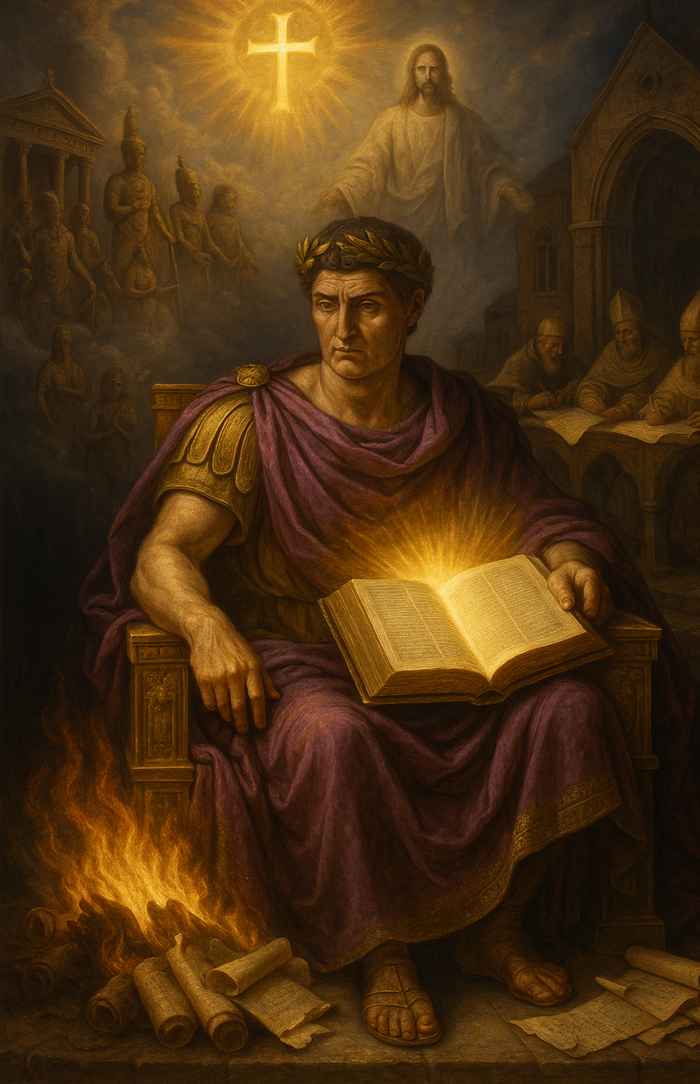
El Emperador que Re-escribió la Biblia
El mensaje de Jesús y de los místicos cristianos conserva intacta su belleza y su poder. Sin embargo, al igual que el resto de las religiones que se expandieron bajo la tutela de los imperios, el cristianismo tampoco se salva…
Artículos relacionados: Creación de las Religiones Abrahámicas – Creando el Cristianismo – Creando el Islam – Creando el Judaísmo – El Emperador que Re-escribió la Biblia – Del Dogma Religioso al Dogma Científico – El Cristianismo Suprimido de los Primeros Siglos – Similitudes en la Creación de las 3 Religiones Abrahámicas
Nota: Hemos sido adoctrinados para creer que las respuestas espirituales se encuentran únicamente en los llamados libros sagrados, escritos hace siglos en contextos muy distintos al nuestro. Sin embargo, a menudo olvidamos que la divinidad sigue manifestándose en cada época, enviando a los maestros de la libertad y del amor que la humanidad necesita en cada momento. Entre los maestros vivos que más me inspiran y me encantan se encuentran Mooji y Peter Crone( (También Gangagi. Eckhart Tolle, Byron Kartie, Teal Swan y otros)
How a Pagan Emperor Rewrote the Bible — The Forbidden History of Christianity!
Cómo un emperador pagano reescribió la Biblia — ¡La historia prohibida del cristianismo!
Resumen en Castellano (≈3.000 palabras)
La historia prohibida del cristianismo y la manipulación de Constantino
Introducción
El cristianismo, tal como lo conocemos en la actualidad, es considerado por millones de personas en todo el mundo como una religión revelada, basada en hechos históricos ocurridos en Palestina durante el siglo I, centrada en la figura de Jesús de Nazaret y transmitida a través de los evangelios y los escritos apostólicos. Sin embargo, este relato ha sido cuestionado por diversas investigaciones críticas que plantean una hipótesis radical: lejos de ser el resultado directo de una revelación divina, el cristianismo habría sido una construcción política impulsada por el emperador romano Constantino en el siglo IV, como estrategia para unificar un imperio fragmentado y en crisis.
La tesis central es que Constantino no fue un converso sincero ni un místico inspirado, sino un estratega pragmático que utilizó la religión como herramienta de poder. Para lograrlo, promovió una síntesis de cultos y tradiciones diversas, impuso un dios unificado, encargó la redacción de escrituras adaptadas a sus fines y suprimió cualquier alternativa que pudiera desafiar la nueva ortodoxia. Este proceso implicó manipulación, censura, destrucción de textos y la creación de una narrativa oficial que se impuso como historia verdadera durante casi dos milenios.
El texto que se resume explora esta hipótesis en profundidad, analizando los acontecimientos desde el Concilio de Nicea hasta las manipulaciones medievales, y muestra cómo la construcción de la fe cristiana sirvió de modelo para el ejercicio de poder institucional en la historia de Occidente.
El contexto del Imperio Romano y la figura de Constantino
En el año 312 d.C., el Imperio Romano se encontraba en una crisis profunda. Más que por invasiones externas o colapsos económicos, el problema provenía de la fragmentación religiosa. En los vastos territorios imperiales coexistían centenares de cultos: dioses tradicionales grecorromanos, religiones mistéricas como el mitraísmo, tradiciones orientales importadas de Persia, India o Egipto, y múltiples grupos cristianos que no compartían un dogma único, sino una gran diversidad de escrituras y doctrinas.
Constantino, recién ascendido al poder, entendió que sin cohesión espiritual el imperio se desmoronaría. Para él, la religión no era principalmente un camino de fe, sino un instrumento de control social y de legitimación política. Su objetivo era claro: crear una religión única, unificada, que integrara elementos diversos y pudiera ser aceptada por la mayor parte de la población.
El Concilio de Nicea y la creación de una religión imperial
En el año 325 d.C., Constantino convocó a lo que se conoce como el Concilio de Nicea, reunión en la que casi 300 líderes religiosos se congregaron en Bitinia. Estos representantes trajeron consigo más de 2000 textos y escrituras, cada uno reflejo de tradiciones distintas y a menudo contradictorias.
Las discusiones fueron intensas, pues no se trataba de un debate teológico refinado, sino de una confrontación entre grupos populares con creencias enfrentadas. En total, se llegaron a proponer más de 50 deidades diferentes como posibles figuras centrales de la nueva religión imperial. Entre ellas estaban Zeus, Horus, Mitra, Krishna y divinidades locales.
Finalmente, Constantino impuso su decisión: combinar elementos de distintas tradiciones para crear una figura híbrida. De esta síntesis surgió Jesucristo, uniendo el nombre del dios druídico Jesús de las islas británicas con atributos del salvador oriental Krishna. La votación fue muy estrecha: 161 a favor y 157 en contra, lo que demuestra cuán frágil y contingente fue el nacimiento oficial del cristianismo tal como lo conocemos.
La figura de Jesús como sincretismo religioso
La construcción de la figura de Jesús Cristo respondió a un cálculo político brillante. En ella se reconocían elementos familiares tanto para los pueblos del este como del oeste del imperio. Los seguidores de cultos mistéricos veían en Cristo similitudes con Mitra y Osiris; los devotos de tradiciones orientales encontraban paralelismos con Krishna; los druidas británicos reconocían su propia divinidad Jesús; los filósofos griegos identificaban enseñanzas morales semejantes a las de Platón o los estoicos.
De esta forma, el nuevo dios unificado era lo suficientemente maleable como para ser aceptado por distintos sectores. El mito de su nacimiento virginal, su sacrificio redentor y su resurrección se construyó como un mosaico de narrativas preexistentes, ensambladas en una biografía coherente gracias al trabajo de los escribas imperiales.
La redacción del Nuevo Testamento
Constantino encargó a su consejero Eusio (Ucius) y a un equipo de escribas recopilar lo mejor de los textos disponibles y crear un único libro fundacional. De esta manera, se seleccionaron relatos, parábolas y enseñanzas de múltiples tradiciones:
-
Del mitraísmo se tomó la idea del nacimiento virginal.
-
De Egipto, los relatos de muerte y resurrección de Osiris.
-
De Grecia, máximas filosóficas y parábolas morales.
-
De la tradición persa, elementos apocalípticos.
-
De la India, ecos de las epopeyas hinduistas.
El resultado fueron cincuenta copias bellamente elaboradas, que sirvieron de base para lo que luego sería el Nuevo Testamento. No se trataba de un testimonio histórico, sino de una construcción literaria cuidadosamente diseñada para consolidar la unidad del imperio.
Evidencias de alteraciones textuales
El hallazgo del Códice Sinaítico en el siglo XIX confirmó la magnitud de las manipulaciones posteriores. Este manuscrito del siglo IV muestra diferencias sustanciales con las versiones modernas de la Biblia. Historias consideradas esenciales, como la resurrección de Jesús o la ascensión al cielo, estaban ausentes en sus formas más antiguas.
Se han identificado más de 14.000 alteraciones en el paso de los manuscritos originales a las ediciones posteriores. El evangelio de Lucas, por ejemplo, ganó 10.000 palabras adicionales respecto a su primera versión. No se trataba de errores de copistas, sino de intervenciones deliberadas que expandieron, corrigieron o adaptaron los relatos a las necesidades doctrinales de cada época.
La censura y el control del Vaticano
La Iglesia no solo fabricó textos, sino que también se aseguró de suprimir las pruebas de esas manipulaciones. En 1198 se crearon los Archivos Secretos Vaticanos, que restringieron el acceso a documentos que podían contradecir la narrativa oficial. En 1562 se instauró el Índice de Libros Prohibidos, para eliminar obras que cuestionaran la ortodoxia.
Este control de la información no fue pasivo, sino activo: bibliotecas enteras fueron destruidas, textos alternativos borrados y los críticos silenciados mediante exilio, persecución o acusaciones de herejía. El término “hereje”, originalmente derivado de la palabra griega hairetikos (“el que elige”), pasó a significar un delito religioso y político.
Apropiaciones culturales: Navidad, Pascua y otros ritos
Muchas de las festividades cristianas actuales son reinterpretaciones de celebraciones anteriores. El 25 de diciembre, fecha del nacimiento de Cristo, era en realidad la festividad de Sol Invictus, el dios solar favorito de Constantino. Los elementos de la Navidad —árboles, regalos, estrellas— provienen de tradiciones romanas, germánicas y persas.
La Pascua, con su énfasis en la resurrección, retoma narrativas ya presentes en Osiris, Dionisio o Mitra. Lo novedoso fue trasladar esas historias míticas al terreno de la historia concreta, situándolas en escenarios reconocibles de Palestina y dándoles protagonistas con nombres propios.
La construcción de la historia cristiana
Para reforzar la legitimidad de la nueva religión, la Iglesia elaboró relatos de persecuciones masivas, martirios heroicos y milagros espectaculares. Sin embargo, los registros romanos muestran que estas persecuciones fueron episódicas y limitadas, y no las campañas sistemáticas que luego narraron los cronistas eclesiásticos.
Las historias de mártires fueron en gran parte invenciones literarias, inspiradas en modelos paganos de héroes divinizados. Este recurso permitió crear una galería de santos y figuras ejemplares que fortalecieron la identidad cristiana frente a las tradiciones rivales.
Falsificaciones medievales
En la Edad Media, la Iglesia continuó fabricando documentos y tradiciones para ampliar su poder. El caso más célebre es la Donación de Constantino, un falso testimonio que afirmaba que el emperador había cedido al papa autoridad temporal sobre Occidente. Durante siglos, este documento sirvió para justificar la supremacía papal hasta que fue demostrado como falso en el Renacimiento.
Asimismo, se produjeron reliquias en masa: fragmentos de la cruz, huesos de santos, objetos milagrosos cuya cantidad excedía toda posibilidad real. También se inventaron genealogías, cartas y biografías atribuidas a apóstoles y padres de la Iglesia.
El protestantismo y las nuevas narrativas
La Reforma del siglo XVI no rompió con la lógica de la manipulación histórica. Los reformadores, para justificar su ruptura con Roma, construyeron la idea de que ellos restauraban la verdadera fe primitiva, libre de corrupciones católicas. Para ello, también debieron reinterpretar los orígenes, minimizar la diversidad de los primeros cristianismos y establecer nuevas genealogías doctrinales.
El evangelismo moderno como invención reciente
El evangelismo contemporáneo, especialmente en su versión estadounidense, es aún más reciente. Sus doctrinas centrales, como la inerrancia bíblica o la salvación personal mediante la aceptación de Jesús, se desarrollaron en los siglos XIX y XX. A pesar de ello, se presentan como continuaciones directas del cristianismo original.
Implicaciones contemporáneas
Lo más relevante de esta hipótesis no es únicamente su valor histórico, sino sus consecuencias actuales. Si el cristianismo fue en gran medida una construcción política, entonces revela cómo funcionan los mecanismos de legitimación institucional en la historia humana. La manipulación de textos, la fabricación de narrativas y la supresión de disidencias no son exclusivos de la Iglesia, sino técnicas reproducidas por gobiernos, medios de comunicación y corporaciones hasta el presente.
El caso del cristianismo se convierte así en una lección sobre el poder de las historias bien contadas y el riesgo de confundir narrativas construidas con hechos históricos.
Conclusión
El cristianismo, lejos de haber surgido como una revelación divina inmutable, aparece en este relato como un proyecto político deliberado de Constantino, diseñado para unificar el Imperio Romano y perpetuar el poder imperial. Su éxito fue rotundo: logró consolidar una religión universal que se convirtió en pilar de la civilización occidental.
Sin embargo, este éxito se sustentó en la manipulación sistemática: textos editados, doctrinas inventadas, festividades apropiadas, falsificaciones históricas y censura de voces alternativas. A lo largo de los siglos, la Iglesia perfeccionó estas técnicas hasta convertirlas en modelo de control institucional.
Hoy, con el acceso creciente a fuentes originales y a la crítica académica, la narrativa oficial comienza a resquebrajarse. Reconocer las raíces políticas y literarias del cristianismo no invalida necesariamente el valor moral o espiritual que millones de personas encuentran en él, pero obliga a replantear la relación entre fe, verdad histórica y poder.
Lo que se revela, en última instancia, es que la religión que moldeó a Occidente no fue simplemente un legado divino, sino la obra maestra de ingeniería política más influyente de la historia.
ENGLISH TRANSCRIPTION OF THE VIDEO
The forbidden history of Christianity. How a pagan emperor rewrote the Bible. What if everything you’ve been told about the origins of Christianity is a carefully constructed lie? What if the religion that has shaped Western civilization for nearly two millennia wasn’t born from divine revelation, but from the political ambitions of a Roman emperor who needed to save his crumbling empire.
Today, we’re diving into one of history’s most explosive secrets. A story so controversial that it’s been buried for over 1,700 years. This isn’t your typical Sunday school lesson. We’re talking about forbidden manuscripts, political conspiracies, and religious cover-ups that reach all the way to the highest levels of the Vatican.
By the end of this investigation, you’ll never look at Christianity the same way again. But before we go any further, let me be crystal clear about something. This isn’t an attack on faith itself. Millions of people find genuine meaning, purpose, and moral guidance in Christian teachings.
What we’re examining today is the historical reality behind how those teachings came to be. Because when you follow the evidence, when you dig beneath centuries of carefully crafted narratives, what you discover is absolutely mindblowing. So grab a coffee, settle in, and prepare to have your world view challenged because what I’m about to reveal will shake you to your core. Picture this.
It’s the year 312 AD and the Roman Empire is literally falling apart at the seams. Not from barbarian invasions or economic collapse, but from something far more dangerous, religious chaos. Across the empire, hundreds of different religious groups are at each other’s throats. Presbyterial factions are fighting over which gods to worship.
Mystery cults are spreading like wildfire. The empire that once conquered the known world through military might is now being torn apart by competing beliefs. Enter Constantine I. He’s just become emperor. And he’s facing the biggest challenge any Roman leader has ever confronted.
His empire isn’t just politically divided, it’s spiritually shattered. And Constantine realizes something that will change the course of human history. If he can’t unite his people under one religious banner, his empire will crumble into dust. But here’s where the story gets really interesting. Constantine wasn’t some deeply spiritual leader who experienced a divine vision.
He was a calculating politician who understood that religion could be the ultimate tool of control. What he did next was nothing short of genius, and it involved the most audacious act of historical manipulation ever attempted. Now, I need you to understand something crucial. The Christianity you know today didn’t exist in Constantine’s time. Not even close. What existed was a chaotic mess of competing religious groups, each with their own sacred texts, their own deities, and their own version of the truth.
Some worshiped Mithra, a Persian god who was supposedly born of a virgin and died for humanity’s sins. Others followed Krishna, an Eastern savior figure whose name literally translates to Christ in Sanskrit. Still others adhered to druidic traditions from the British Isles, worshiping a deity called Jesus. Sound familiar? It should because Constantine was about to combine all of these into something completely new.
The year is 325 AD and Constantine has just issued an unprecedented decree. He’s calling together representatives from every religious faction in the empire for what he’s calling the Council of Nika. This gathering in the city of Bethnia would become the most consequential religious meeting in human history. But it wasn’t a spiritual awakening.
It was a political power play of staggering proportions. Picture the scene. Nearly 300 religious leaders from across the empire converging on this ancient city. Each carrying scrolls and texts representing their particular beliefs. They brought with them over 2,000 different religious documents. 2,000. Each representing different gods, different saviors, different versions of divine truth.
The diversity was staggering. The conflict was inevitable. These weren’t refined theologians debating subtle points of doctrine. These were rough, often uneducated religious leaders representing the masses, teaching a wild mixture of legends, paradoxes, and competing beliefs. They’d been at war with each other for decades, sometimes literally.
And now Constantine expected them to somehow agree on a single unified religion. The debates were fierce. Personal agendas clashed with cultural traditions. Eastern mysticism battled western pragmatism. At one point 53 different deities were actually put forward as candidates for the new unified religion. 53 Zeus was on the table.
So was Mithra to Horus from Egypt. Krishna from India, even local tribal gods that most of the empire had never heard of. But Constantine held the ultimate authority. And his decision would echo through history in ways that still shape our world today. After intense deliberation, he made a choice that was pure political genius.
He decided to combine elements from multiple traditions. The British druidic deity Jesus would be merged with the eastern savior god Krishna. The result Jesus Christ, a hybrid deity designed to appeal to both western and eastern factions of his empire. The vote was incredibly close. 161 prespits approved the decision. 157 opposed it. That’s right.
The foundation of Christianity as we know it was decided by a margin of just four votes. Four votes that would reshape human civilization. But Constantine wasn’t finished. Creating a new deity was just the beginning. He needed a scripture to go with it.
So he turned to his adviser with an instruction that would have profound consequences. Search through all these religious texts and take whatever is good from each one. combine the best elements into a single book that will serve as the foundation for our new religion. This wasn’t divine inspiration. This was religious engineering on a massive scale. Ucius and his team of scribes began the monumental task of weaving together myths, legends, and teachings from dozens of different traditions. They borrowed the virgin birth narrative from mythraism.
They adapted resurrection stories from Egyptian mythology. They incorporated moral teachings from Greek philosophy. They even lifted entire passages from Hindu epics and Persian apocalyptic literature. The result was the first compilation of what would eventually become the New Testament.
50 beautifully crafted copies were produced and distributed throughout the empire. But here’s the crucial point that most people don’t understand. These weren’t historical accounts of actual events. They were carefully constructed narratives designed to serve Constantine’s political purposes and it worked brilliantly. The new religion provided the unity Constantine desperately needed.
Different factions could see elements of their own beliefs reflected in the new scripture. Eastern followers recognized Krishna-like qualities in the new Christ figure. Western adherence found familiar druidic elements. The empire finally had a unifying force. But the story doesn’t end there. Because what Constantine created was just the beginning.
Over the following centuries, the church would continue to modify, edit, and expand these texts to serve its evolving needs. The New Testament you might have on your shelf today bears little resemblance to those original 50 copies that created. How do we know all this? Because the evidence has been hiding in plain sight for over a century.
In 1859, a German scholar named Constantine Tyishonorf made a discovery that shook the foundations of Christianity. Deep in a monastery on the Sinai Peninsula, he found something extraordinary. The oldest complete Bible known to exist. The Codeex Citicus dating back to the 4th century.
Just decades after Constantine’s council, what Tishonorf discovered was earthshattering. This ancient Bible was dramatically different from modern versions. Key stories that form the backbone of Christian belief was simply missing. The resurrection of Jesus not there in the original version of Mark’s gospel. The ascension into heaven absent from the earliest manuscripts.
The virgin birth not mentioned in the oldest texts. Even more shocking, Tishonorf found evidence of massive editorial changes. Over 14,000 alterations between the ancient manuscript and modern New Testaments. 14,000 entire passages had been added, removed, or completely rewritten. The Gospel of Luke had gained 10,000 additional words compared to its earliest version.
10,000 words that weren’t there originally. This wasn’t the work of scribal errors or innocent copying mistakes. These were deliberate, systematic changes made over centuries to transform Constantine’s political creation into what we recognize as modern Christianity. The church had essentially rewritten its own history, backdating later editions to make them appear original and divinely inspired.
But here’s where it gets really disturbing. The church knew about these changes. They’ve always known. In fact, they’ve been actively involved in covering them up for over a millennium. In 1198, Pope Innocent III established what became known as the Vatican Secret Archives, restricting access to early Christian documents.
In 1562, Pope Pius IV created the Index of Forbidden Books, systematically suppressing or altering early church records that contradicted official doctrine. Think about the implications of this. We’re talking about an institution that has shaped the beliefs of billions of people, influenced wars, determined moral codes, and claimed divine authority, all while knowing that its foundational texts were essentially fabricated for political purposes.
The evidence keeps mounting. Modern scholars have identified direct parallels between New Testament stories and earlier religious traditions. The sermon on the mount contains passages that are virtually identical to earlier Greek philosophical texts. The parables attributed to Jesus mirror stories from Hindu epics that predate Christianity by centuries.
Even Paul’s letters considered foundational to Christian theology contain direct quotes from Greek and Roman philosophers presented as if they were original Christian insights. We’re not talking about vague similarities or general themes. We’re talking about word for word copying from earlier sources rebranded and presented as divine revelation.
It’s the most successful act of intellectual appropriation in human history. And the most remarkable part, the church has quietly admitted to much of this. The Catholic Encyclopedia acknowledges that the Gospels were originally written anonymously and only later attributed to specific apostles.
It concedes that many foundational texts were heavily edited to align with evolving doctrine. These aren’t accusations from hostile critics. These are admissions from the church itself. So what does all this mean? It means that Christianity as it exists today is fundamentally different from what most believers think it is. Instead of being a divinely inspired religion based on historical events, it’s a sophisticated political construction that borrowed heavily from earlier traditions to create a unifying force for the Roman Empire. This doesn’t necessarily invalidate the moral teachings or the personal meaning that millions find in
Christian faith, but it does raise profound questions about authority, truth, and the nature of religious belief itself. How can an institution claim divine authority when its foundational texts are demonstrabably fabricated? What does it mean for moral guidance to be based on stories that were consciously constructed rather than divinely revealed? The rabbit hole goes even deeper than what I’ve shared today.
We haven’t even scratched the surface of how the church systematically destroyed alternative texts, manufactured historical timelines, or created elaborate cover stories to hide the evidence of its origins. We haven’t discussed the specific techniques used to backdate later writings or the sophisticated methods employed to suppress dissenting voices throughout history. The deeper you dig into this historical deception, the more disturbing the picture becomes.
Because what Constantine set in motion wasn’t just the creation of a new religion. It was the beginning of one of history’s most elaborate cover-ups, a systematic campaign to erase evidence and rewrite the past that continues to this day.
Let me take you back to that pivotal moment at the Council of Nika when those presenters voted to create this hybrid deity. They weren’t just making a theological decision. They were participating in what would become the greatest literary fraud in human history. Because once Constantine had his unified god, he needed stories to go with it. Epic stories, miraculous stories, stories that would capture imaginations and inspire devotion across his vast empire. This is where Ucius comes back into our story.
Constantine’s chief adviser wasn’t just tasked with compiling existing religious texts. He was essentially commissioned to create a religious bestseller from scratch. Think of him as history’s first ghost writer, except instead of writing for a celebrity, he was crafting the biography of a god. The process was methodical and calculated.
Ucius and his team of scribes had access to the greatest library of religious literature ever assembled. They had creation myths from Egypt, hero stories from Greece, prophecies from Persia, philosophical treatises from India. It was like having access to Netflix, Amazon Prime, and Disney Plus all at once. Except instead of binge watching, they were cherrypicking the best elements to create the ultimate religious narrative. Consider how they constructed the nativity story.
They took the virgin birth concept straight from mythism, where the god Mithra was born from a rock to a virgin mother. They borrowed the star following shepherds from Persian astronomical traditions. the three wise men. That’s lifted directly from Zoroastrian prophecy about magi who would recognize a divine king.
Even the December 25th birth date wasn’t original. It was already the established birthday of Soul Invictus, the unconquered sun god that Constantine had previously favored. But here’s where it gets really clever. They didn’t just copy these elements wholesale. They adapted them, refined them, made them fit together into a coherent narrative that would appeal to people from completely different cultural backgrounds. A Roman citizen could hear echoes of their familiar mystery religions.
A Greek philosopher could recognize moral teachings that resonated with their intellectual traditions. An Egyptian could see familiar themes of death and resurrection. It was religious marketing at its most sophisticated. The resurrection story is perhaps the most telling example of this creative borrowing.
The concept of a god dying and rising again wasn’t new. Osiris had been doing it in Egypt for millennia. Dionis had his own resurrection mythology in Greece. What Ucius did was take these familiar themes and craft them into something that felt both ancient and immediate, both mystical and relatable. They even borrowed the crucifixion narrative.
Crru punishment, yes, but the affiction was a Roman idea of a divine figure suffering on a cross for humanity’s redemption was already present in various forms across multiple traditions. The genius was in the way they combined these elements with the political reality of Roman justice, making the story feel historically grounded while maintaining its mythological power.
Now, you might be thinking, «Surely some people at the time recognized what was happening. Surely someone called out this obvious borrowing and adaptation.» And you’d be right. They absolutely did. But Constantine had a solution for that, too. Anyone who questioned the new official religion, anyone who pointed out the obvious parallels to earlier traditions, anyone who possessed texts that contradicted the official narrative was branded a heretic.
Fascinating in this context, it comes from the Greek word. The word heretic itself is hereticos, which simply means able to choose. Think about that. The original heretics weren’t necessarily people who believed in evil or false things. They were people who insisted on their right to choose their own beliefs instead of accepting the statemandated version.
In Constantine’s empire, the ability to choose your own spiritual path became a crime. This is where the story takes a dark turn. Because maintaining this religious fiction required more than just creative writing. It required the systematic suppression of evidence, the destruction of alternative texts, and the silencing of dissenting voices. The early church didn’t just create a new religion.
It launched what might be history’s first comprehensive disinformation campaign. The scope of this suppression was staggering. Entire libraries were burned. Manuscripts that contained alternative versions of Christian stories were systematically hunted down and destroyed. Scholars who questioned the official narrative were excommunicated, exiled, or worse.
The church created what was essentially an ancient version of thought police roaming the empire to ensure ideological conformity. But they made one crucial mistake. They were so focused on destroying texts that contradicted their narrative that they didn’t always think about preserving the evidence of their own fabrication. Some of the original material survived, hidden away in remote monasteries, forgotten in dusty archives, buried beneath centuries of accumulated manuscripts. This brings us to one of the most shocking discoveries in modern biblical scholarship.
When Dr. Tishonorf found that ancient Bible at St. Catherine’s monastery. He wasn’t just discovering an old book. He was uncovering the smoking gun that proved centuries of deliberate deception. The Codeex Citicus wasn’t just different from modern Bibles in minor ways. It was fundamentally different in its most crucial elements.
The Gospel of Mark, which most scholars consider the earliest Gospel, originally ended with the women finding an empty tomb and running away in fear. That’s it. No resurrection appearances, no great commission, no triumphant ending, just confusion and terror. Everything that Christians today consider essential to the Easter story, the very foundation of their faith, was added later.
We’re not talking about subtle theological differences. We’re talking about the complete absence of what are now considered the most important events in human history. The implications of this are staggering. If the resurrection appearances were later additions, if the ascension into heaven was a fabrication, if even the virgin birth was a retrofit, then what exactly was original to the story? What if anything was based on actual historical events rather than creative religious fiction? Modern textual analysis has revealed the layers of editing like an archaeological dig
through literature. Scholars can now identify different editorial hands, trace the evolution of stories across centuries, and pinpoint exactly when specific passages were inserted into the text. It’s like having a time-lapse video of how a religion was constructed piece by piece. Take the Gospel of Luke for instance.
The version we have today contains roughly 10,000 more words than the earliest manuscripts. 10,000 words that were added over centuries to flesh out the story, to answer theological questions that later generations found important, to align the narrative with evolving church doctrine. It’s the literary equivalent of a director’s cut, except the additions were presented as having been there all along.
The most disturbing part of this process was how seamlessly the church integrated these fabrications into its official doctrine. They didn’t just add new stories and admit they were new. They backdated them, claimed they had always been part of the original revelation, and declared anyone who questioned their authenticity to be a heretic or a fool.
This wasn’t accidental. It wasn’t the result of innocent copying errors or natural textual evolution. It was a deliberate, systematic campaign to rewrite history in real time. The church was essentially practicing what we would now call historical revisionism on a massive scale, except they were doing it to their own foundational documents. The techniques they used were sophisticated for their time.
They would create multiple copies of edited texts and distribute them widely while simultaneously seeking out and destroying older versions that contradicted the new narrative. They established scriptorums, essentially ancient publishing houses that specialized in producing standardized versions of approved texts while suppressing variance.
They also developed elaborate authentication systems, creating false provenence for their fabricated texts. They would attribute writings to famous apostles who had died centuries earlier, forge letters from early church fathers, and even create entirely fictional historical figures to serve as witnesses to events that never happened. But perhaps most cleverly, they turned their critics arguments against them.
When scholars pointed out obvious parallels between Christian stories and earlier pagan myths, the church claimed this was actually evidence of divine foreshadowing. God, they argued, had planted these similar stories in earlier cultures to prepare humanity for the true revelation that would come later. It was a brilliant rhetorical move that transformed evidence of borrowing into proof of divine planning.
This strategy worked so well that it persisted for over a millennium. Even when Renaissance scholars began noticing the obvious parallels between Christianity and earlier religions, the church’s explanation was so entrenched that most people accepted it without question.
The idea that earlier myths were pale shadows of Christian truth became orthodox doctrine taught in universities and preached from pulpits across Europe. Meanwhile, the church continued its campaign of historical manipulation. They established institutions specifically designed to control information flow and suppress inconvenient evidence. The Vatican Secret Archives created in the late 12th century became a repository for documents too sensitive for public viewing.
The index of forbidden books established in the 16th century systematically censored materials that contradicted church teachings. These weren’t defensive measures designed to protect legitimate religious doctrine. They were offensive operations aimed at maintaining a carefully constructed historical fiction. The church wasn’t just interpreting evidence in their favor.
They were actively hiding evidence that contradicted their narrative and manufacturing evidence that supported it. The scope of this deception becomes clear when you realize how much of early Christian history has been lost or altered. We have almost no independent contemporary accounts of the events described in the Gospels.
No Roman historians mention the miraculous events that supposedly drew crowds of thousands. No Jewish sources record the trial and execution that allegedly caused an earthquake and darkened the sky. It’s as if the most important events in human history happened in a complete historical vacuum. This absence of contemporary evidence isn’t an accident. It’s the result of centuries of systematic suppression and fabrication.
The church didn’t just fail to preserve alternative accounts. They actively sought them out and destroyed them while simultaneously creating false historical records to fill the gaps in their narrative. The result is that what most people think they know about early Christian history is actually a carefully constructed illusion maintained through centuries of institutional deception and intellectual manipulation.
The real story of how Christianity began is far more complex, far more political, and far more deliberately fabricated than most believers could ever imagine. The web of deception goes even deeper when you examine how the church manipulated its own early history. They didn’t just fabricate religious texts.
They manufactured an entire historical timeline complete with fictional characters, backdated documents, and elaborate cover stories that would make a modern intelligence agency jealous. Let me paint you a picture of how sophisticated this operation really was. The church created what historians now call retroactive authentication.
They would write documents centuries after the supposed events, then appear ancient and authoritative. They use elaborate techniques to make them developed methods for aging parchment, created artificial wear patterns on manuscripts, and even invented entire biographical details for fictional early church leaders. Take the figure of Paul the Apostle for instance.
Modern scholarship has revealed something absolutely shocking about those famous epistles that form the backbone of Christian theology. Many of them weren’t written by Paul at all. They were actually adaptations of existing philosophical works, particularly the writings of Appalonius of Tiana, a wandering Greek philosopher who lived in the first century.
Appalonius was a real historical figure, well documented by multiple independent sources. He traveled throughout the Roman Empire teaching a form of reformed Pythagorean philosophy, performing what his followers considered miraculous healings and attracting large crowds with his charismatic speaking style.
Sound familiar? It should because his biographical details were systematically borrowed and retrofitted to create the Apostle Paul. The church took Appalonius’s genuine letters which dealt with philosophical and ethical questions and simply rebranded them as Christian epistles. They changed references to Greek philosophical concepts into Christian theological terms.
They replaced Appalonius’s discussions of Pythagorean number mysticism with Christian symbolism. They transformed his ethical teachings about virtue and wisdom into doctrines about faith and salvation. This wasn’t subtle adaptation. This was wholesale intellectual theft on a massive scale. Entire passages from Appalonius’s authentic writings appear word for word in what are now considered foundational Christian texts.
The famous passage about love in first Corinthians that’s lifted directly from Appalonius’s letter to the philosophers of Ephesus. the description of spiritual gifts and their proper use borrowed from his treatise on the different forms of wisdom. But here’s what makes this even more disturbing. The church didn’t just steal these ideas and present them as Christian originals.
They systematically destroyed Appalonius’s actual writings to cover their tracks. Today we have only fragments of his genuine works preserved mostly in quotations by later authors who cited him before the church’s suppression campaign reached them. This pattern of theft and destruction repeated itself across the ancient world. Wherever the church found existing philosophical or religious traditions that contained useful material, they would appropriate what served their purposes and eliminate what didn’t.
They strip mind the intellectual heritage of the classical world, keeping the gems and burying the evidence of where they found them. The process was so thorough that most people today have no idea how much of what they consider uniquely Christian wisdom actually originated in earlier traditions. The golden rule, that’s from Confucious, five centuries before Christianity.
The concept of loving your enemies found in Buddhist teachings that predate Jesus by hundreds of years. Even the Lord’s Prayer contains elements borrowed directly from earlier Jewish and pagan prayer formulas. But the church’s fabrication efforts went beyond just borrowing existing material. They also created entirely fictional historical events to support their narrative.
The persecution of Christians under Roman emperors, for example, was vastly exaggerated and in some cases completely invented. Don’t get me wrong, there were certainly instances of conflict between early Christian communities and Roman authorities.
But the systematic empirewide persecution that the church claims shaped its early history, that’s largely fictional. Roman records, which are extensive and detailed about legal proceedings and imperial policies, contain very little evidence of the massive anti-Christian campaigns that supposedly defined the first three centuries after Christ. What actually happened was much more mundane.
Early Christian groups were occasionally prosecuted for specific crimes like tax evasion, disturbing the peace, or refusing to participate in civic duties. These isolated incidents were then woven together by later church historians into a grand narrative of religious persecution that justified the church’s eventual rise to power. The story of martyrdom became a particularly powerful tool for the church.
They created elaborate fictional accounts of saints who supposedly died rather than renounce their faith complete with miraculous events, dramatic speeches, and inspiring examples of religious devotion. These stories served multiple purposes. They provided role models for believers, justified the church’s claims to moral authority, and created a sense of historical continuity that linked contemporary Christianity to its supposed apostolic origins.
The problem is that most of these martyrdom accounts are complete fiction. Modern historical analysis has shown that the vast majority of early Christian martyr stories were created centuries after the supposed events, often borrowing details from earlier pagan hero cults and mystery religions. The church essentially created a fictional pantheon of Christian heroes to compete with the traditional Roman and Greek mythological figures that still captured popular imagination. This brings us to one of the most shocking
aspects of the church’s historical manipulation. They didn’t just fabricate the distant past. They continued creating false historical records well into the medieval period, constantly revising and expanding their narrative to meet contemporary political needs.
The donation of Constantine, for example, was a forged document that claimed the Roman Emperor had given the Pope temporal authority over the entire Western Roman Empire. This fabrication was used for centuries to justify papal political power until Renaissance scholars finally proved it was a fake. But by then, it had already served its purpose, establishing precedents and expectations that shaped European politics for over a thousand years.
The church also created false genealogies connecting contemporary religious leaders to the apostles, forged letters from early church fathers supporting later doctrinal developments, and even manufactured archaeological evidence to support their historical claims. They established entire industries devoted to creating religious relics, producing thousands of fragments of the true cross, enough pieces of saints bones to reconstruct entire armies of holy people and miraculous objects with completely fictional provenence.
What makes this systematic deception so remarkable is how well it worked. The church didn’t just fool uneducated peasants and gullible believers. They convinced scholars, intellectuals, and even skeptical investigators for over a millennium.
Their fabrication techniques were so sophisticated, their narrative control so complete that even people who had good reason to be suspicious often accepted the official story. This success wasn’t accidental. The church invested enormous resources in maintaining their historical fiction. They established schools specifically devoted to training scribes in the proper copying and editing of manuscripts.
They created networks of monasteries that served as information control centers, ensuring that approved versions of texts were widely distributed while suppressing varants. They developed theological arguments that made questioning official church history equivalent to questioning God himself. But perhaps most importantly, they understood something about human psychology that modern propagandists would recognize immediately.
People want to believe compelling stories, especially stories that give their lives meaning and purpose. The church didn’t just offer theological doctrine. They offered a complete worldview, a grand narrative that explained human history, provided moral guidance, and promised ultimate justice and redemption. Um, the fabricated history wasn’t just window dressing for this worldview.
It was essential to its psychological power. People needed to believe that their faith was rooted in actual historical events, that their moral teachings came from divine revelation, that their religious authorities could trace their legitimacy back to the original apostles. The church understood that faith built on acknowledged fiction would never have the same emotional and psychological impact as faith built on purported historical fact. This is why the evidence of fabrication is so devastating to traditional
Christian claims. It’s not just that specific stories were borrowed or embellished. It’s that the entire historical foundation of the religion was consciously constructed rather than divinely revealed. Every major element of the Christian narrative, from the virgin birth to the resurrection, from the apostolic succession to the persecution accounts, shows evidence of deliberate fabrication designed to serve specific political and psychological purposes. The implications of this historical manipulation extend
far beyond religious belief. They raise fundamental questions about authority, truth, and the nature of historical knowledge itself. If one of the most powerful and influential institutions in human history was built on systematic deception, what does that tell us about other claims to authority and legitimacy? How many other historical narratives that we take for granted might actually be carefully constructed fictions designed to serve particular interests? The church’s fabrication campaign was so successful that it essentially created a parallel version of ancient history that millions of people still accept as fact.
They didn’t just influence how people understood religion. They shaped how entire civilizations understood their past, their identity, and their relationship to truth itself. And the most disturbing part, much of this evidence has been available to scholars for over a century. The discoveries at St.
Catherine’s Monastery, the textual analysis revealing layers of editorial changes, the identification of borrowed passages from earlier sources. All of this has been documented in academic literature for generations. Yet somehow the broader public has remained largely unaware of these findings, continuing to accept historical narratives that scholars have long known to be fabricated.
This disconnect between academic knowledge and popular belief isn’t accidental. It’s the result of continued institutional efforts to suppress and marginalize inconvenient evidence. The same patterns of information control that the early church pioneered continue to operate today, though in more subtle and sophisticated forms.
The Vatican secret archives still exist, still restricting access to potentially damaging historical documents. Church affiliated universities still discourage research that might undermine traditional narratives. Religious authorities still dismiss scholarly findings that contradict official doctrine, often without seriously engaging with the evidence.
Meanwhile, the fabricated version of Christian history continues to be taught in schools, preached from pulpits, and accepted by billions of people who have no idea how extensively the historical record has been manipulated. The success of Constantine’s political project has been so complete that most people can’t even imagine Christianity without the fictional elements that were added centuries after its supposed founding.
But the truth has a way of surfacing even when powerful institutions try to bury it. The evidence of fabrication keeps accumulating. The scholarly consensus keeps shifting and more people are beginning to ask uncomfortable questions about the historical foundations of their beliefs.
The carefully constructed narrative that has shaped Western civilization for nearly two millennia is finally beginning to crack under the weight of its own contradictions. What happens when that narrative finally collapses? When the general public becomes aware of the systematic deception that underlies one of history’s most influential institutions. The implications are staggering, not just for religious belief, but for our entire understanding of truth, authority, and historical knowledge. The answer might already be unfolding before our eyes. Because what we’re witnessing
today isn’t just an academic debate about ancient manuscripts. It’s the beginning of a fundamental shift in how humanity understands one of its most foundational institutions. Let me show you exactly how deep this fabrication goes by examining one of the most sacred Christian holidays.
Christmas, December 25th, the supposed birthday of Jesus Christ. Except here’s the problem. Early Christian communities had absolutely no idea when Jesus was supposedly born. The Gospels don’t give a date. Early church fathers never celebrated a birthday. For the first three centuries of Christianity’s existence, December 25th had nothing whatsoever to do with Jesus.
So where did this date come from? It was the birthday of Soul Invictus, the unconquered son, Constantine’s favorite deity before he created Christianity. December 25th was already the most important religious holiday in the Roman Empire, marking the winter solstice when the sun began its return to strength.
Constantine simply transferred this existing celebration to his new hybrid god. But it gets even more calculated than that. The church didn’t just steal the date. They systematically appropriated every major element of the winter solstice festival and rebranded it as Christian. The giftgiving traditions borrowed from Roman satinia. The evergreen trees and holly decorations lifted directly from Germanic and Celtic winter ceremonies.
Even the star on top of the Christmas tree comes from ancient astronomical celebrations of the winter solstice. The nativity story itself reads like a greatest hits compilation of earlier religious traditions. The star announcing a divine birth.
That’s straight from Persian astrology where celestial events routinely announce the arrival of important figures. The three wise men following the star. Those are the Zoroastrian magi, religious figures who were already established in Persian traditions centuries before Christianity existed. The shepherds receiving angelic announcements. That narrative appears in multiple earlier traditions.
From a Roman pastoral poetry to Egyptian religious texts about divine messengers appearing to humble workers. Even the manger birth in a stable was borrowed from existing stories about gods being born in humble circumstances to demonstrate their connection to common people.
What Ucius and his team did was essentially create a religious remix, taking familiar elements that would resonate with people across the empire and weaving them into a coherent narrative that felt both new and ancient at the same time. It was storytelling as political engineering designed to give Constantine’s subjects something they could embrace without completely abandoning their existing cultural traditions.
The Easter story follows the same pattern. The resurrection narrative that forms the absolute core of Christian belief. It’s a direct adaptation of mystery religion themes that were already popular throughout the Mediterranean. Dionis died and was reborn. Osiris was murdered and resurrected. Mithra conquered death and ascended to heaven. These weren’t obscure beliefs.
They were mainstream religious ideas that millions of people already accepted as spiritual truth. What the church did was take these familiar resurrection themes and give them a specific historical setting complete with named characters, geographic locations, and detailed chronologies. Instead of mythological time, they placed the story in recent history.
Instead of supernatural realms, they set it in recognizable places like Jerusalem and Galilee. This gave the borrowed narrative a sense of historical authenticity that the older myths lacked. But here’s where the deception becomes truly sophisticated. The church didn’t just borrow these resurrection stories and present them as Christian originals.
They actively worked to discredit and suppress the earlier traditions they had stolen from. They labeled the mystery religions as demonic deceptions, claimed that Satan had planted false resurrection stories to confuse people about the true resurrection of Christ. This strategy was brilliant because it turned evidence of borrowing into proof of authenticity.
When critics pointed out obvious parallels between Christian stories and earlier pagan myths, the church could claim this was actually Satan’s attempt to undermine Christianity by creating counterfeit versions of true events. The similarities weren’t evidence of theft. They were evidence of spiritual warfare.
This rhetorical move was so effective that it persisted for over 1500 years. Even today, when scholars point out the obvious connections between Christianity and earlier religions, many believers accept the church’s ancient explanation without question.
The idea that Satan planted false religions to confuse humanity about true Christianity has become so embedded in Christian thinking that it immunizes believers against evidence of their religion’s fabricated origins. Meanwhile, the church continued expanding and refining their narrative throughout the medieval period. They didn’t just create the original Christian story and then preserve it unchanged.
They kept adding new elements, developing new doctrines, and inventing new historical details whenever their political situation required it. The doctrine of papal infallibility, for example, wasn’t established until 1870. The immaculate conception of Mary wasn’t declared official Catholic doctrine until 1854. The Trinity, now considered absolutely fundamental to Christian theology, wasn’t formally codified until the Council of Constantinople in 381, and even then it remained controversial for centuries.
Each of these developments required new historical justification. The church couldn’t simply announce that they were creating new doctrines. They had to claim that these ideas had always been part of authentic Christian teaching, hidden in scripture and preserved by apostolic tradition. This meant continuously revising their historical narrative, manufacturing new evidence, and suppressing materials that contradicted their evolving theology. The pattern becomes clear when you step back and look at the bigger picture.
Christianity isn’t a religion that was revealed once and then preserved unchanged through history. It’s a constantly evolving political and theological system that has continuously reinvented itself to meet changing circumstances all while claiming to represent unchanging divine truth.
This ongoing fabrication process explains why there are so many different versions of Christianity today. Catholic, Orthodox, Protestant, Evangelical, each represents a different stage in this continuous process of adaptation and reinvention. Each claims to represent the authentic original Christianity, but they’re all actually products of specific historical moments when the church needed to modify its narrative for political or theological reasons. The Protestant Reformation, for instance, wasn’t just a theological dispute about salvation and
authority. It was a political rebellion that required creating new historical narratives to justify breaking away from Rome. Protestant scholars had to rewrite Christian history to show that the Catholic Church had corrupted original Christianity and that they were returning to authentic apostolic teaching. But they faced the same problem that had plagued the church since Constantine’s time.
How do you create legitimacy for new religious ideas without admitting that you’re innovating? The Protestant solution was to claim that they were removing later Catholic additions and returning to biblical Christianity. They positioned themselves as historians uncovering authentic early Christian practice rather than innovators creating new religious systems.
This required its own form of historical manipulation. Protestant scholars had to minimize evidence of diversity in early Christianity, suppress information about the political origins of the New Testament, and create new narratives about apostolic succession that bypassed Rome entirely. They essentially had to outfabricate the Catholics, creating even more elaborate historical fictions to justify their theological innovations.
The result is that virtually every Christian denomination today is built on layers of historical fabrication stretching back to Constantine’s original political project. Each group claims direct connection to original Christianity, but they’re all actually products of specific moments when religious authorities needed to create new legitimacy for their particular interpretation of the faith.
modern despite claiming to represent biblical liter evangelical Christianity represents perhaps the most extreme example of this paternalism and original apostolic teaching. Evangelical theology is actually a relatively recent invention developed primarily in 19th and 20th century America to address specific cultural and political challenges.
The doctrine of biblical inherency, now considered fundamental to evangelical identity, wasn’t widely accepted until the late 1800s. The emphasis on personal salvation through accepting Jesus as personal savior developed during American revival movements and has little connection to earlier Christian practice. Even the evangelical interpretation of biblical prophecy with its focus on endtime scenarios and the rapture was largely invented by 19th century theologians like John Nelson Derby and popularized through institutions like Dallas Theological Seminary. Yet evangelical leaders present these relatively recent innovations as if they
represent authentic first century Christianity unchanged since the time of the apostles. They’ve essentially created their own version of the same historical fiction that has characterized Christianity since Constantine, complete with manufactured connections to ancient practice and suppression of evidence that contradicts their narrative.
This pattern of continuous fabrication and historical revision explains why biblical scholarship has had so little impact on popular Christian belief. It’s not that the evidence for fabrication is weak or controversial among experts. The scholarly consensus about the constructed nature of Christian origins is actually quite strong and has been building for over two is that agnol centuries.
The problem during this evidence would require admitting that the entire institutional structure of Christianity is built on systematic deception. Church leaders, seminary professors, and religious authorities would have to confess that they’ve been teaching historical narratives they know to be false.
The financial, social, and psychological costs of such honesty would be catastrophic for religious institutions. So instead, they’ve developed sophisticated strategies for compartmentalizing scholarly knowledge and popular belief. Seminary students learn about textual criticism and historical analysis, but they’re taught to interpret this evidence in ways that don’t threaten traditional faith claims.
Scholars are encouraged to focus on narrow technical questions rather than drawing broader conclusions about Christian origins. Academic findings are kept within professional circles. While popular religious education continues to present fabricated historical narratives as unquestioned fact, this system of institutional knowledge management has been remarkably effective at preserving religious authority despite overwhelming evidence of historical manipulation.
Most believers remain completely unaware that the historical foundations of their faith have been systematically debunked by generations of scholarly research. They continue to accept fabricated narratives created by Constantine’s political project as if they were established historical facts. But this compartmentalization is becoming increasingly difficult to maintain in the information age.
Academic research is more accessible than ever before. Independent scholars are publishing findings without institutional constraints. Digital archives are making primary sources available to anyone with internet access. The carefully controlled information environment that allowed religious institutions to suppress inconvenient evidence for centuries is rapidly breaking down.
The implications of this information revolution extend far beyond religious belief. What we’re witnessing is the collapse of one of history’s most successful systems of institutional authority built on nearly two millennia of systematic deception and information control. The techniques that Constantine’s church pioneered, historical fabrication, narrative management, evidence suppression, authority claims based on manufactured legitimacy. These same techniques have been used by countless other institutions throughout history.
Governments have created mythological national origins to justify political authority. Educational institutions have taught fabricated histories to support ideological agendas. Economic systems have been legitimized through manufactured historical narratives about natural market processes and inevitable progress.
The church’s success in maintaining fabricated authority for nearly 2,000 years has provided a template that other institutions have eagerly copied. Understanding how Christianity was constructed as a political project reveals the mechanisms through which all forms of institutional authority operate. It shows how powerful groups create legitimacy through historical manipulation, how they suppress dissenting voices, how they manage information flow to maintain control over popular belief, and how they adapt their narratives to meet changing circumstances while claiming to represent unchanging truth.
The evidence that Christianity was fabricated by Constantine for political purposes isn’t just important for understanding religious history. It’s a you understand the interests when case study in how institutional power operates, how authority people can be systematically deceived by those who claim to act in their best is manufactured and maintained, and how ordinary techniques that were used to create and maintain the Christian historical fiction. You begin to recognize similar patterns everywhere. Political movements that claim ancient
legitimacy for recent innovations. Economic theories presented as natural laws rather than ideological constructs. Educational curricula that teach manufactured narratives while suppressing contrary evidence. Media narratives that shape public opinion through selective presentation of information.
The same psychological mechanisms that allowed the church to convince billions of people to accept fabricated history continue to operate in modern institutional contexts. People still want compelling narratives that give their lives meaning and purpose. They still prefer simple explanations to complex realities.
They still tend to trust authority figures who claim special knowledge or divine sanction. They still resist information that threatens their fundamental beliefs about themselves and their world. This is why the evidence about Christianity’s fabricated origins is so threatening to religious institutions and why it has profound implications that extend far beyond theological debate.
It reveals the fundamental mechanisms through which institutional authority operates in human society. It shows how easily even sophisticated populations can be manipulated through systematic deception and information control. And it demonstrates that institutions we consider most trustworthy and legitimate may actually be built on foundations of deliberate fraud.
The question facing us now isn’t just whether Christianity is historically accurate. The question is, what happens to human civilization when one of its foundational institutional models is revealed to be based on systematic deception? How do we rebuild trust in authority when we discover that authority has been systematically abusing that trust for nearly two millennia? How do we distinguish between legitimate and illegitimate claims to institutional power when one of our most trusted institutions turns out to be built on fabrication? These aren’t just academic questions. They’re practical challenges that will shape the future of human
society as information becomes more accessible and institutional deception becomes harder to maintain. The collapse of the Christian historical narrative is just the beginning of a much larger reckoning with institutional authority and the nature of truth itself.
We’re living through what might be the most significant collapse of institutional authority in human history. And it’s not happening because of external attacks or military conquest. It’s happening because the truth is finally catching up with centuries of carefully managed lies. Think about what this means on a personal level.
If you were raised in a Christian household, if you attended Sunday school, if you based major life decisions on biblical teachings, you’ve essentially been living inside a historical fiction created by a Roman emperor for political purposes. Your moral framework, your understanding of human nature, your beliefs about life and death, all of it traces back to Constantine’s fabrication project.
This isn’t your fault. You weren’t supposed to know. The system was specifically designed to prevent you from knowing. Generations of religious authorities, seminary professors, and church leaders have maintained this deception, not necessarily out of malice, but because admitting the truth would destroy the entire institutional structure they’ve devoted their lives to defending. But here’s where it gets really personal.
Once you understand how this fabrication was accomplished, once you see the techniques that were used to manipulate historical narratives and control information, you start recognizing the same patterns everywhere. Political campaigns that manufacture grassroots support.
News organizations that shape public opinion through selective reporting. educational institutions that teach ideologically convenient versions of history while suppressing inconvenient evidence. The methods Constantine pioneered, creating compelling narratives from borrowed elements, claiming ancient authority for recent innovations, suppressing dissenting voices, manufacturing historical evidence.
These same techniques are being used today by governments, corporations, media organizations, and educational institutions around the world. Consider how modern political movements operate. They don’t just propose policies and ask for your support based on practical merits. They create elaborate mythologies about national identity, historical destiny, and moral righteousness.
They claim their recent innovations represent returns to founding principles. They suppress information that contradicts their narratives while amplifying evidence that supports them. The techniques are identical to what Ucius used when compiling the New Testament. Take elements that resonate with your target audience.
Weave them into a coherent narrative that feels both familiar and inspiring. Present the result as ancient wisdom rather than contemporary construction. Suppress alternative versions of events. Create institutions to maintain and propagate your preferred narrative. This isn’t conspiracy theory speculation. This is documented historical methodology that has been refined and perfected over nearly two millennia.
The church didn’t just accidentally stumble into effective propaganda techniques. They pioneered and systematized methods for manufacturing legitimacy and controlling popular belief that have become the standard playbook for institutional authority.
Understanding this helps explain why so many people today feel like they’re living in an era of alternative facts and competing realities. It’s not that truth has become more relative or that people have become more gullible. It’s that the information control systems that once allowed institutions to maintain unified narratives are breaking down, revealing the underlying fabrication and manipulation that was always there. The internet hasn’t created fake news.
It’s exposed how much of what we considered legitimate news was always carefully managed information designed to serve institutional interests. Social media hasn’t made people more susceptible to propaganda. It’s revealed how much of what we considered authoritative knowledge was always propaganda, just better disguised and more professionally produced.
What we’re experiencing now is the same thing that would have happened in Constantine’s time if ordinary people had suddenly gained access to all those religious manuscripts that the Council of Nika had rejected. If 4th century Romans could have read the original sources that borrowed from, if they could have compared the fabricated Christian narratives to their authentic predecessors, if they could have seen the political calculations behind the religious engineering, the entire project would have collapsed before it got started. That’s essentially what’s happening today with
Christianity and numerous other institutional authorities. The primary sources are becoming available. The fabrication techniques are being exposed. The political motivations behind seemingly spiritual or scholarly or journalistic enterprises are becoming visible to ordinary people who were never supposed to see behind the curtain.
Religious institutions are responding to this crisis exactly the way you’d expect institutions built on systematic deception to respond. They’re doubling down on their historical claims while simultaneously trying to shift the conversation away from historical accuracy and toward personal meaning and community value.
You’ll hear religious leaders arguing that it doesn’t matter whether the biblical narratives are historically accurate because they provide moral guidance and spiritual comfort. You’ll see seminary professors distinguishing between historical truth and religious truth as if there were some meaningful difference between facts and fabrications when it comes to foundational claims about reality.
These are the desperate rhetorical moves of institutions that know their authority depends on historical claims they can no longer credibly defend. They’re trying to preserve their power and influence by convincing people that truth doesn’t really matter.
That authority can be legitimate even when it’s based on acknowledged falsehoods. That institutions should be trusted regardless of whether their foundational narratives are accurate. But this strategy faces a fundamental problem. If historical accuracy doesn’t matter for religious authority, then why does every major Christian denomination continue to insist that their particular interpretation represents authentic biblical teaching? If truth is irrelevant to legitimacy, then why do religious institutions spend enormous resources on apologetics and historical arguments designed to defend their credibility? The answer is that they know historical
accuracy absolutely does matter for institutional authority. They know that admitting their foundational narratives are fabricated would destroy their ability to command obedience and extract resources from believers. They’re trying to have it both ways, claiming that truth doesn’t matter while simultaneously insisting that their version of events is true.
This contradiction is becoming increasingly difficult to maintain as more people gain access to primary sources and scholarly analysis. The compartmentalization strategies that once allowed religious institutions to keep inconvenient evidence away from ordinary believers are failing.
Seminary trained pastors who learned about textual criticism and historical analysis in graduate school are finding it harder to preach traditional narratives to congregations that can easily access the same information online. The result is a growing crisis of authority that extends far beyond religious institutions.
Because once people understand how thoroughly they’ve been deceived about something as fundamental as the historical origins of Christianity, they start questioning everything else they’ve been told by institutional authorities. If the church could maintain a fabricated historical narrative for nearly 2,000 years, what other institutions might be operating on similarly false foundations? If religious leaders could systematically deceive billions of people while claiming moral authority, what does that say about the credibility of other authority figures who make similar claims? These questions are already reshaping political, educational, and media landscapes around
the world. Traditional gatekeepers are losing their ability to control information flow and shape public opinion. Established authorities are finding their credibility challenged by people who have access to primary sources and alternative perspectives that were once carefully suppressed.
So what we’re witnessing isn’t just the collapse of a religious narrative. We’re watching the unraveling of the entire model of institutional authority that Constantine created 17 centuries ago. The same techniques of fabrication, suppression, and narrative control that built Christianity have been used to construct countless other systems of power throughout history.
And now, for the first time in nearly two millennia, ordinary people have the tools to see through the deception. The truth about Christianity’s origins isn’t just a historical curiosity. It’s a masterclass in how institutional power really works, how authority is manufactured, and how easily entire civilizations can be built on carefully constructed lies.
Once you understand how Constantine’s political project became the world’s largest religion, you’ll never look at claims to authority the same way again. The question now isn’t whether these revelations will reshape our world. They already are. The question is whether we’ll learn from this history of deception or repeat it. Because the techniques that created Christianity are still being used today.
And until we recognize them for what they are, we’ll keep falling for the same old tricks that have been fooling humanity for centuries. The empire of lies that Constantine built is finally crumbling. What we build in its place will determine whether future generations inherit truth or just more sophisticated versions of the same ancient deceptions.